


Pro Forged Piston Set (+.080" / 94mm) with 20R Head | 12.0:1 Compression
Bring race-proven technology to your high-performance 20R engine build. Built on over a decade of success with our legendary big-bore forged aluminum piston kits, these pistons are engineered to withstand the rigorous demands of high-RPM racing and extreme operating environments. Proven through years of testing, this premium forged set consistently delivers more horsepower and up to 15% more torque than factory piston sets.
Kit Includes
- Premium Forged Aluminum Pistons (Optimized for 20R Heads)
- Lightweight Tool-Steel Chromoly Wrist Pins
- High-Strength Spiral Locks
- Professional-Grade LC Pro Ring Sets
Key Features & Specifications
- Bore Size: 94.00MM (+0.080" Overbore)
- Compression Ratio: High-compression 12.0:1 ratio-specifically dome-profiled for 20R cylinder heads to maximize power and thermal efficiency.
- Structural Integrity: Forged construction provides vastly superior tensile strength and thermal resistance to easily withstand the rigorous demands of racing and high-RPM use.
Custom Machining & Installation Notes
- Custom Camshaft Valve Clearance: For builders running aggressive, high-lift, or high-duration aftermarket camshaft profiles, custom piston notching service is available to ensure adequate valve-to-piston clearance. Please see our Notch Labor service for more details or to add this machining service to your build.
- Bore Inspection: Your cylinder block must be precision bored and honed to exactly 94.00mm to achieve the critical piston-to-wall clearances required for high-performance forged alloys. Always provide these pistons to your automotive machinist prior to final block honing.
| Note: Images are for illustration purposes only. Images may not represent the product listed. Please contact customer service with any questions or concerns: 1-928-505-2501. |
- 1985-1995 22R 2.4L Engines w/ 20R Head
- 1985-1995 22RE 2.4L Engines w/ 20R Head
CP Forged Piston Set
Phase 1: Cylinder Honing Recommendations for CPN & CPN2 Ring Packs
When utilizing premium CPN and CPN2 piston rings, precise cylinder wall preparation is critical to ensure proper seating, minimal friction, and optimal oil retention.
Technical Specifications & Geometry
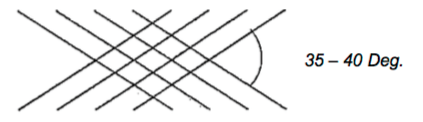
- Honing Process: Plateau Honing
- Cross-Hatch Angle: 35 to 40 degrees (relative to the horizontal plane)
Execution Notes
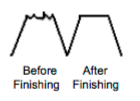
- Surface Conditioning: Plateau honing is required to shear away the sharp microscopic peaks left by initial boring passes while maintaining the necessary valleys to hold vital lubrication.
- Angle Control: Maintaining a strict 35 to 40 degree cross-hatch angle guarantees the perfect balance between oil distribution and drainage under extreme operating conditions.
Phase 2: Abrasive Selection & Multi-Stage Grit Progression
To achieve the precise surface roughness required for proper ring seating on gray cast iron engine blocks and Nikasil cylinders, adhere to the following abrasive specifications:
1. Initial Honing Stage
Choose the appropriate stone type based on your shop equipment to establish the core cross-hatch depth:
- Conventional Vitrified Stones: Use #220 to #280 grit
- Diamond Stones: Use #325 to #550 grit
2. Plateau Finishing Stage
After completing the initial honing passes with your primary stones, finish the cylinder walls using one of the following methods to remove jagged structural peaks, torn metal, or folded material:
- Fine Conventional Abrasive: Perform final smoothing passes using a #400 to #600 grit stone.
- Surface Conditioning Sweep: Sweep the cylinder bores using a flexible brush or a specialized nylon-bristle plateau honing tool.
- Warning: Skipping the plateau finishing stage leaves microscopic peaks that will instantly shear and destroy the ring face during initial startup. This final conditioning step is mandatory to eliminate jagged material and guarantee proper oil retention.
Phase 3: Surface Roughness Verification & Manufacturer Compliance
Before running the final production passes, cross-reference your stone selection with your honing equipment manufacturer guarantee that the selected grits will achieve the precise micro-finish requirements listed below:
- Mean Roughness Depth (Rz): 59 - 138 μin (1.5 - 3.5 μm)
- Roughness Average (Ra): 15 - 35 μin (0.4 - 0.9 μm)
Phase 4: Piston Ring End Gap Verification
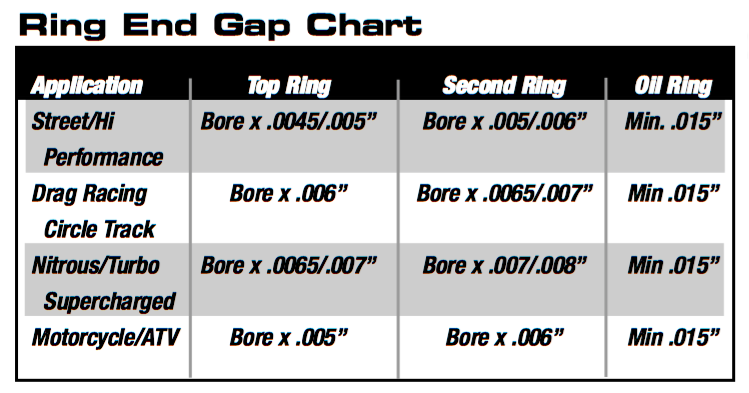
Warning: Failure to verify and adjust the piston ring end gap prior to final assembly will result in ring tips expanding, touching and binding at operating temperature. This will cause catastrophic engine failure, broken ring lands, and severe cylinder wall scoring. The final end gap geometry remains the sol responsibility of the engine builder.
Operational Guidelines
- Application Variables: The specifications provided below are general baseline guidelines. High-stress configurations-included forced induction (turbocharged or supercharged applications), nitrous oxide, filled blocks, and endurance racing-require increased structural clearance to handle elevated thermal expansion.
- If your specific application requires custom variance, contact technical support at 949-567-9000 before clearancing the rings.
Calculation & Conversion Procedure
Before using the application multiplier table, all metric cylinder bores must be converted to inches.
- Convert Bore to Inches: Divide the metric millimeter bore size by 25.4.
- Apply Application Factor: Multiply the resulting inch-bore size by the specific application constant shown in your technical spec sheet.
- Formula 1: Metric Bore (mm) / 25.4 = Bore Size (Inches)
- Formula 2: Bore Size (Inches) x Application Factor = Required Target Ring Cap
Calculation Example (Street Application Top Ring):
- 81mm / 25.4 = 3.189 inches
- 3.189 inches x 0.005 - 0.016 inches target end gap.
Phase 5: Piston Ring Gap Measurement Procedures
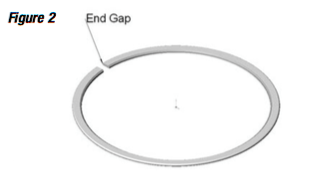
Warning: Visual estimation is strictly prohibited. You must use precision measuring equipment to verify the end gap of every single ring. If the measured ring gap is less than the minimum calculated specification for your exact bore size, you must file-fit the rings to achieve the proper clearance. Failure to do so will result in terminal engine failure.
Measurement Setup & Execution
- Install Torque Plate (If Applicable): Bolt the torque plate to the engine block and torque it to factory specifications. This simulates the actual cylinder distortion that occurs when the cylinder head is installed, ensuring your measurements are highly accurate.
- Squaring the Ring: Insert the piston ring into the cylinder bore. Push the ring down below the deck surface, ensuring it is perfectly square to the deck. Using an inverted piston without rings is the recommended method to push the ring down evenly.
- Measure Clearances: Insert a calibrated feeler gauge (or an equivalent precision ring-gap measuring device) into the ring end gap to determine the exact clearance.
Custom Fitting Adjustments
- File Fitting: If the measured gap falls below your target calculation, use a dedicated piston ring filer to carefully remove material from the ring tips. Always file inward toward to center of the ring to prevent chipping the outer face or coatings.
- Deburring: After filing, lightly deburr the sharp edges of the ring tips with a fine stone to prevent them from scoring the cylinder walls during operation.
Phase 6: Precision Ring Filing & Orientation Procedures
Warning: Incorrect ring orientation or improper filing techniques will disrupt the oil film, cause severe blow-by, high oil consumption, and lead to immediate engine damage. Adhere strictly to the marking and structural profiles outlined below during installation.
Mechanical Precision Filing Technicalities
- Tool Requirements: Always use a dedicated manual or electric piston ring filing tool to adjust the end gap.
- Directional Technique: Position the ring firmly against the grinding wheel and file exclusively in an inward direction (from the outside face toward the center of the ring). Filing outward will chip, fracture, or peel the specialized face coatings (such as plasma moly or chrome).
- Squareness Verification: Keep the ring perfectly square to the filing wheel sides to ensure the finished ring tips remain parallel. Angular or uneven ring ends will distort heat transfer and cause improper gap readings.
- Bore Size Variance Note: Ring sets are precision-manufactured for specific nominal bore diameters. For every 0.001 inch the actual cylinder bore measures over the intended manufactured specification, the ring end gap will automatically expand by approximately 0.00314 inches (calculated as Pi multiplied by the bore variance).
- Change in Ring Gap = Change in Bore x 3.1416
Phase 7: Component Orientation & Placement Architecture
Before final insertion onto the piston lands, evaluate the ring profile to determine the absolute correct installation orientation.
1. Top Compression Ring Orientation
Inspect the top ring surfaces thoroughly and install according to the structural markers present:
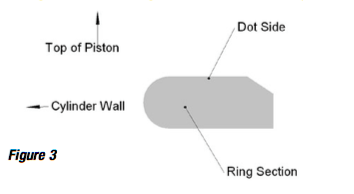
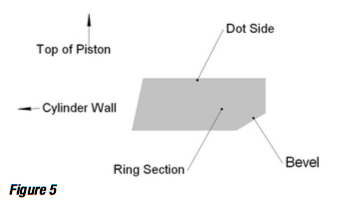
- Laser Markings/Dots: If the ring face features a stamped dot, alphanumeric writing, or a manufacturer emblem, install the ring with this side facing up toward the cylinder head.
- Internal Bevel Profiles: Unmarked top compression rings featuring an inner chamfer or bevel must be installed with the bevel side facing up toward the cylinder head.
- Symmetrical Profiles: Symmetrical rings completely devoid of dots, writing, or internal bevels are bidirectional and can be installed with either side facing up.
2. Second Ring Compression Ring Orientation
Inspect the second ring surfaces thoroughly and install according to the structural markers present:
- Laser Markings/Dots: If the ring face features a stamped dot, alphanumeric writing, or a manufacturer emblem, install the ring with this side facing up toward the cylinder head.
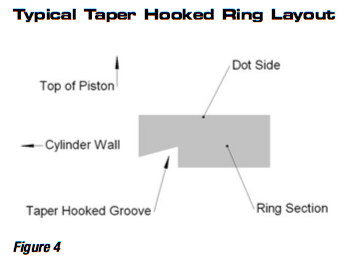
- Taper Hook Groove/Napier Style: If the second ring utilizes a specialized taper hook groove profile, it must be installed with the hook or groove facing down toward the oil pan. This design acts as a mechanical scraper to manage the oil film on the cylinder wall.
- Internal Bevel Profiles: Unmarked second compression rings featuring an inner chamfer or bevel must be installed with the bevel side facing down toward the oil pan.
- Symmetrical Profiles: Symmetrical rings completely devoid of markings, writing or internal bevels are bidirectional and can be installed with either side facing up.
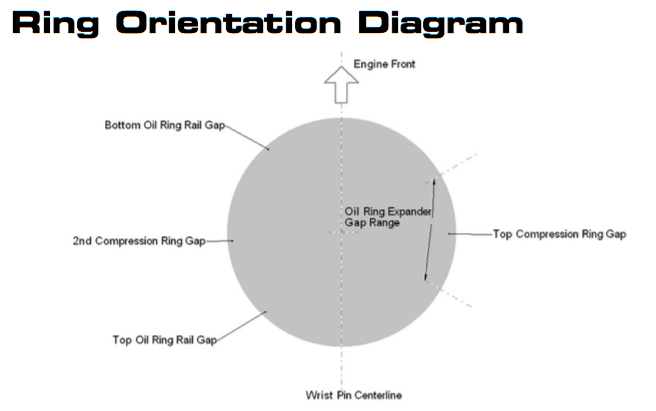
3. Three-Piece Oil Control Ring Architecture
Adhere to these exact physical parameters when preparing and seating the multi-piece oil ring assembly:
- Component Configuration: Most high-performance oil rings utilize a three-piece design consisting of two steel scraper rails and a central ventilation expander ring.
- Rail End Gap Limits: Measure the end gap of both the top and bottom scraper rails independently. The gap must not be less than 0.015 inches.
- Expander Care: Ensure the ends of the expander butt together perfectly without overlapping. Do not modify, file, or cut the expander ring under any circumstances. Modifying the expander will destroy the radial tension of the oil ring assembly and cause severe oil consumption.
Legal Disclaimer & Product Warranty Policy
Due to the extreme operating environments and high-stress nature of high-performance and racing applications, all CP Pistons/Pankl products and services are sold strictly "As is" and "With All Faults."
1. Warranty Exclusion
CP Pistons/Pankl provides no warranty whatsoever, whether express or implied. This includes, but is not limited to, any implied warranties of merchantability or fitness for a particular purpose.
It is expressly understood, agreed upon, and considered a core condition of doing business that the purchaser assumes all risk regarding the selection, quality, performance, and use of these components. CP Pistons/Pankl provides all buyers with a fill and complete opportunity to inspect and examine all parts, inventory, and services prior to purchase or installation.
2. Limitation of Liability
Under no circumstances shall CP Pistons/Pankl be held liable for any special, incidental, indirect, or consequential damages resulting from the sale, installation, modification, or use of these products.
Excluded Damages for which CP Pistons/Pankl bears no responsibility include, but are not limited to:
- Damage to or loss of other property, engine components, or support equipment.
- Loss of profits, business revenue, or commercial value.
- Costs associated with purchased replacement goods or secondary labor.
- Legal or financial claims made by customers of the primary purchaser.
By retaining and installing these components, the engine builder and end-user explicitly accept these terms in full.


