

Weber 38 Carb & Intake Performance Package | Manual Choke | Stock Weber Air Cleaner
One of the absolute best ways to unlock extra horsepower and throttle response from your Toyota 22R engine is to upgrade the induction system. When modifying your engine, matching your components is critical to achieving maximum efficiency. LC Engineering has done the homework for you, combining the perfect blend of parts into a single, comprehensive bolt-on package.
Kit Includes
- Weber 38 Carburetor Kit: Features a reliable manual choke configuration
- Offenhauser Performance Downdraft Intake Manifold: Designed with a 2-barrel Weber carburetor flange.
- Thermostat Housing Gasket: Premium round rubber-style gasket.
- Stock Weber Air Cleaner: Budget-friendly assembly with a serviceable filter element.
Component Breakdown
Offenhauser Single-Plane Downdraft Intake Manifold
Engineered with a large, open plenum and optimized runners, this single-plane manifold supplies your engine with the unrestricted airflow needed to generate maximum horsepower.
- Power Band: Provides excellent mid-range to upper-RPM power without sacrificing critical low-end torque.
- Direct Bolt-On: Features an integrated Weber flange so you can mount your performance carburetor directly without restrictive adapters.
- Factory Integration: Equipped with all the same vacuum and sensor ports as your stock manifold. You won't have to worry about adapting mismatched fittings to hook up your vacuum lines and temperature sensors.
Weber 38 Synchronous Carburetor
Unleash the sheer power of your performance vehicle with the legendary Weber 38. This is a two-barrel synchronous carburetor, meaning both barrels open simultaneously to deliver immediate fuel and crisp acceleration. It is trusted by countless racers and off-roaders who require top-tier performance from their Toyota 4-cylinder engines.
- Automatic Transmission Note: This carburetor does not include provisions for an automatic transmission kick-down cable. If your factory kick-down cable attaches to the firewall bell crank, you will not be affected. If it attaches directly to the stock carburetor, modifications will be required.
- Fuel Line Note: The factory fuel line from the mechanical pump is roughly 1/16" smaller than the Weber regulator/carburetor inlet line. A slight amount of pressure is all that is required to fit the stock line over the inlet.
Stock Weber Air Cleaner & Serviceable Filter
For those on a budget, this kit includes a standard Weber rectangular chrome air cleaner. This assembly works exceptionally well on unmodified or mildly built engines. For heavily modified or high-RPM engines, consider upgrading to our maximum-airflow LCE Billet Air Cleaner or custom K&N assemblies.
Tech Specifications & Optional Upgrades
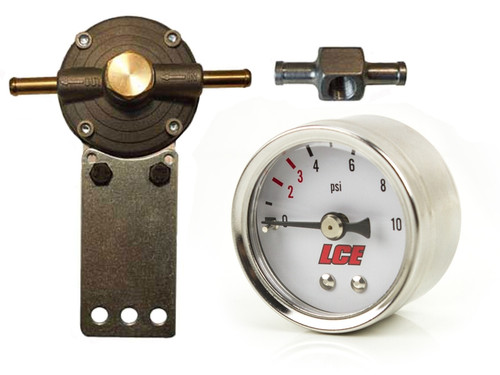
- Critical Fuel Requirements: The Weber 38 requires a consistent 2.5 to 3 PSI of fuel pressure. Running excessive factory pressure will flood the carburetor. We highly recommend pairing this kit with our LCE Fuel Pressure Regulator Kit. (Part #: 1035056).
- Water Plate Fitment: This single-plane manifold utilizes an 8-bolt water plate located underneath the manifold (included). Note: Dual-plane manifolds utilize an 11-bolt layout.
- Cylinder Head Port Matching: If you are running an LCE Performance Cylinder Head (or plan to upgrade in the future), we can professionally port-match your new intake manifold to match any of our cylinder head stages. Contact our sales staff to coordinate this service.
Companion Parts & Accessories
- Weber Spiral Spacer: (Part #: 1033023)
- Intake Manifold Gasket: (Part #: 1032021)
- Teflon Intake Manifold Gasket: (Part #: 1032091)
- Pro Water Block-Off Kit: (Part #: 1016015)
- Intake Manifold Plug Kit: (Part #: 1032050)
- Intake Manifold Stud Kit: (Part #: 1035048)
- Thermostat Housing Adapter: (Part #: 1032086)
- 8-Bolt Water Plate (Under Manifold Replacement): (Part #: 1032003)
Related Weber 38 Carburetor Kits
If this specific configuration doesn't perfectly match your build, browse our full lineup of Weber 38 packages.
- Weber 38 Carburetor Only (20R/22R Manual Choke: (Part #: 1030038)
- Weber 38 Carburetor Only (20R/22R Electric Choke): (Part #: 1030037)
- Weber 38 Carburetor Kit w/ Manual Choke (20R/22R): (Part #: 1030034)
- Weber 38 Carburetor Kit w/ Electric Choke (20R/22R): (Part #: 1030030)
- Weber 38 Carb Kit w/ K&N Filter & LCE Billet Cleaner: (Part #: 1030033)
- Weber 38 Carb Kit w/ Oversized K&N Filter (11" x 2"): (Part #: 1030027)
- Weber 38 Carb & Intake Performance Package (22R Electric Choke): (Part #: 1030042)
- Weber 38 Carb & Intake Performance Package (20R Manual Choke): (Part #: 1030009)
- Weber 38 Carb & Intake Performance Package (20R Electric Choke): (Part #: 1030006)
| Note: Images are for illustration purposes only. Images may not represent the product listed. Please contact customer service with any questions or concerns: 1-928-505-2501. |
- 1981-1995 22R 2.4L Engines
CLICK HERE to open a printable PDF version of these instructions.
What is a Genuine Weber Carburetor?
This is a hotly debated topic, but the confusion is mostly kept alive by competitors selling what can only be described as a "similar" imitation carburetor. These knock-off carbs are cheap copies of the original, but they lack the legendary quality and precision calibration of the real deal.
Fortunately, genuine European-manufactured Weber carburetors are easily distinguished from imitations by two distinct characteristics.
- The Trademark Stamp: Authentic Webers feature the official, crisp "W" logo stamped directly into the carburetor body casing.
- Country of Origin: Genuine units are explicitly and clearly cast or marked with their true point of origin: "Made in Spain".
If it doesn't have the "W" stamp and the Spanish origin mark, it isn't a genuine European Weber.

How to Spot a Genuine Weber Carburetor vs. Imitations.
With various merchants claiming to sell "Genuine" Weber carburetors, it can be incredibly confusing for consumers to know what they are actually buying. To understand how to protect your build from cheap knock-offs or misbranded alternatives, it helps to understand what "Genuine" truly means in the automotive world.
The Quick Checklist: Spotting the Imitations
If you are trying to verify a carburetor, look out for these common telltale signs of a non-European copy:
- Stickers Instead of Stamps: Many "similar" carburetors feature no permanent branding cast into the metal-only a removable paper or vinyl sticker.
- Missing Country of Origin: If it does not explicitly say "Made in Spain" cast directly into the housing, it is not an original European Weber.
- Suspiciously Smooth Casting: While ultra-smooth metal casting might look visually appealing at first glance, it often indicates a cheaper, lower-grade aluminum alloy than what is used in European manufacturing.
- Black Choke Elements: Pay close attention to the electric/water choke mechanism. Authentic Redline Weber carburetors imported from Europe utilize a white choke element, whereas many clones feature a black choke element.
The Weber History: Brand Licensing vs. True Heritage
The Weber carburetor company was founded by Eduardo Weber in 1935 in Bologna, Italy. Original production remained in Italy until 1992, when the entire manufacturing infrastructure was relocated to Spain. When classic car enthusiasts and racers talk about a "Genuine Weber," this Italian-engineered, Spanish-built lineage is exactly what they mean.
Today, the "WEBER" trademark us owned by Magneti Marelli of Italy. Magneti Marelli also happens to own SOLEX, which was Weber's primary competitor for nearly 60 years. Because Magneti Marelli owns the intellectual property, they regularly license the "WEBER" name to various global manufacturing entities.
The "Combination Branding" Loophole
This corporate structure creates a legal loophole known as combination branding. Just because a product is legally allowed to wear a badge does not mean it matches the original engineering heritage.
- The South American Solex: Certain distributors import South American-designed Solex carburetors, slap a licensed "Weber" sticker on them, and market them as "Genuine Webers." While legally permitted under licensing agreements, these are structurally and internal-component-wise Solex carburetors, not true Italian designs.
- The Clone Proliferation: This practice expanded to popular performance models. Many of the 32/36 DGV and 38 DGS series carburetors in the market are built outside of Spain with zero connection to the original tooling or quality control standards, yet they legally exploit the license Weber name.
In our book, "Genuine" implies two things: real and original. There is only one original Weber layout, and that is the European-produced, Italian-designed carburetor built exclusively in Spain.
Genuine European Models vs. Mismarked Variants
To ensure you are getting the precision calibration, uncompromised airflow, and long-term tunability of an authentic unit, use the model breakdown below:
Authentic European-Built Webers
(Italian-Designed, Manufactured in Spain with "Made in Spain" & "W" Cast Markings)
- 32/36
- 38 DGAS
- 40 DCOE
- 45 DCOE
Mismarked/Licensed Clones to Avoid
(Look closely for lack of origin stamps and sticker-only branding)
- 32/36 DGV / DGEV: No country-of-origin markings; sticker-branded.
- 38/38 DGAS: No origin markings; sticker-branded.
- 34 DGEC / 36 DGEC: Actually a South American Solex design disguised with a Weber sticker.
- 40 IDF / 44 IDF: Clone variations missing any cast-in country-of-origin details.

Global Market Presence & The Final Verdict
This goes to show that the issue is not isolated to North America alone-these licensed, imitation carburetors are being marketed and distributed worldwide.
Summary: What This Means for the Consumer
When it comes down to it, making the right choice requires understanding exactly what you are buying and why. Your choice is clear: choose the original, Italian-engineered, European-built Weber carburetor, or opt for a "similar" imitation from elsewhere at a lower price point.
A Changing Landscape
Prior to 2001, every reputable Weber carburetor conversion kit on the market utilized authentic European carburetors. While there were always competitors, the undisputed leader was Weber of Italy.
That dynamic shifted when parent company Magneti Marelli acquired both the Weber name and its historic 60-year competitor, Solex. Ironically, Magneti Marelli's own historical archives note that Eduardo Weber originally founded his company to eliminate Italy's dependency on buying carburetors from the French Solex company. Today, corporate licensing allows those lines to blur completely. While it is legally permissible for them to license the badge-arguably allowing a company to slap a "Weber" nameplate on the automotive equivalent of a frozen dinner-it fundamentally distorts what the consumer expects from a premium heritage brand.
Making Your Choice: The Original vs. The Imitation
When you invest your hard-earned money into a vehicle build, ask yourself what standard of performance you want:
- The Legend: The genuine European Weber is an Italian-designed masterpiece. It remains the absolute benchmark by which all two-barrel carburetors are measured, built to the exact same rigorous European quality control standards thar established its reputation over 30 years ago.
- The "Similar" Alternative: These are branded clones, often purchased by consumers who have no idea what they are missing out on true European engineering and casting quality.
The Redline Assurance
The choice is simple. To ensure you are getting a legitimate, European-manufactured Weber carburetor that is properly jetted, tunes, and calibrated for your specific application, ensure your kit comes from Redline.
Redline's exclusive use of authentic European-built Webers (manufactured in Spain) guarantees you receive the exact same race-proven quality that has anchored premium conversion kits for over three decades.
If a deal from another merchant sounds too good to be true, it probably is. Protect your engine, your performance, and your wallet by demanding the real thing.
Technical Reference:
- Weber Specification Sheet: (Part #: 1030069)

Weber Replacement & Optional Parts
Keep your Weber carburetor performing at its peak with our selection of genuine replacement components, tuning kits, and accessories:
- Jetting Gasket Kit: (Part# 1035026)
- Rebuild Kit: (Part# 1035024)
- Lean Jet Kit: (Part# 1035014)
- Rich Jet Kit: (Part# 1035006)
- Weber Foam Float: (Part# 1032037)
- Weber Carburetor Linkage: (Part# 1035021)
- Electric Choke (DGEV): (Part# 1035030)
- Weber Power Valve: (Part# 1035074)
- Fuel Pressure Regulator Kit: (Part# 1035056)
- Stock Replacement Air Cleaner: (Part# 1034036)
CLICK HERE to open a printable PDF version of these instructions.
What is a Genuine Weber Carburetor?
This is a hotly debated topic, but the confusion is mostly kept alive by competitors selling what can only be described as a "similar" imitation carburetor. These knock-off carbs are cheap copies of the original, but they lack the legendary quality and precision calibration of the real deal.
Fortunately, genuine European-manufactured Weber carburetors are easily distinguished from imitations by two distinct characteristics.
- The Trademark Stamp: Authentic Webers feature the official, crisp "W" logo stamped directly into the carburetor body casing.
- Country of Origin: Genuine units are explicitly and clearly cast or marked with their true point of origin: "Made in Spain".
If it doesn't have the "W" stamp and the Spanish origin mark, it isn't a genuine European Weber.
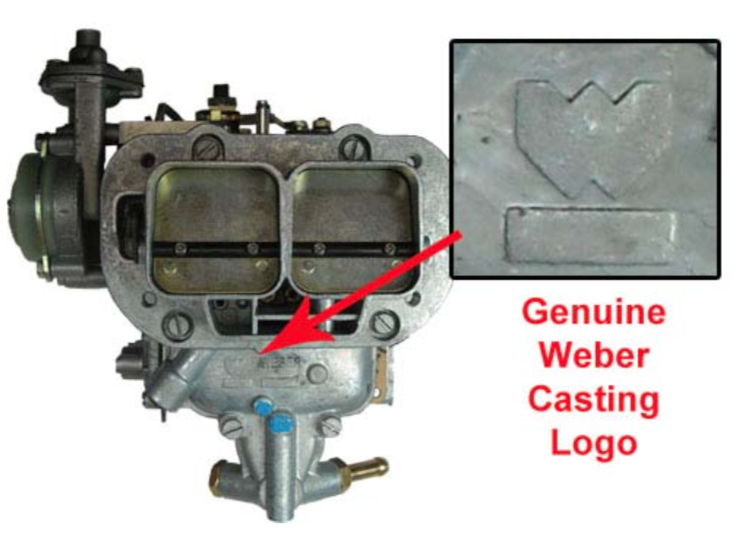
How to Spot a Genuine Weber Carburetor vs. Imitations.
With various merchants claiming to sell "Genuine" Weber carburetors, it can be incredibly confusing for consumers to know what they are actually buying. To understand how to protect your build from cheap knock-offs or misbranded alternatives, it helps to understand what "Genuine" truly means in the automotive world.
The Quick Checklist: Spotting the Imitations
If you are trying to verify a carburetor, look out for these common telltale signs of a non-European copy:
- Stickers Instead of Stamps: Many "similar" carburetors feature no permanent branding cast into the metal-only a removable paper or vinyl sticker.
- Missing Country of Origin: If it does not explicitly say "Made in Spain" cast directly into the housing, it is not an original European Weber.
- Suspiciously Smooth Casting: While ultra-smooth metal casting might look visually appealing at first glance, it often indicates a cheaper, lower-grade aluminum alloy than what is used in European manufacturing.
- Black Choke Elements: Pay close attention to the electric/water choke mechanism. Authentic Redline Weber carburetors imported from Europe utilize a white choke element, whereas many clones feature a black choke element.
The Weber History: Brand Licensing vs. True Heritage
The Weber carburetor company was founded by Eduardo Weber in 1935 in Bologna, Italy. Original production remained in Italy until 1992, when the entire manufacturing infrastructure was relocated to Spain. When classic car enthusiasts and racers talk about a "Genuine Weber," this Italian-engineered, Spanish-built lineage is exactly what they mean.
Today, the "WEBER" trademark us owned by Magneti Marelli of Italy. Magneti Marelli also happens to own SOLEX, which was Weber's primary competitor for nearly 60 years. Because Magneti Marelli owns the intellectual property, they regularly license the "WEBER" name to various global manufacturing entities.
The "Combination Branding" Loophole
This corporate structure creates a legal loophole known as combination branding. Just because a product is legally allowed to wear a badge does not mean it matches the original engineering heritage.
- The South American Solex: Certain distributors import South American-designed Solex carburetors, slap a licensed "Weber" sticker on them, and market them as "Genuine Webers." While legally permitted under licensing agreements, these are structurally and internal-component-wise Solex carburetors, not true Italian designs.
- The Clone Proliferation: This practice expanded to popular performance models. Many of the 32/36 DGV and 38 DGS series carburetors in the market are built outside of Spain with zero connection to the original tooling or quality control standards, yet they legally exploit the license Weber name.
In our book, "Genuine" implies two things: real and original. There is only one original Weber layout, and that is the European-produced, Italian-designed carburetor built exclusively in Spain.
Genuine European Models vs. Mismarked Variants
To ensure you are getting the precision calibration, uncompromised airflow, and long-term tunability of an authentic unit, use the model breakdown below:
Authentic European-Built Webers
(Italian-Designed, Manufactured in Spain with "Made in Spain" & "W" Cast Markings)
- 32/36
- 38 DGAS
- 40 DCOE
- 45 DCOE
Mismarked/Licensed Clones to Avoid
(Look closely for lack of origin stamps and sticker-only branding)
- 32/36 DGV / DGEV: No country-of-origin markings; sticker-branded.
- 38/38 DGAS: No origin markings; sticker-branded.
- 34 DGEC / 36 DGEC: Actually a South American Solex design disguised with a Weber sticker.
- 40 IDF / 44 IDF: Clone variations missing any cast-in country-of-origin details.
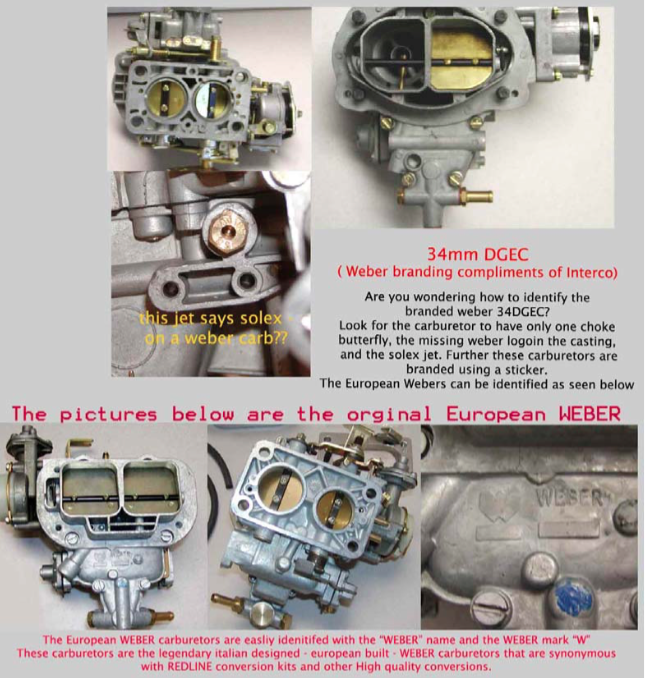
Global Market Presence & The Final Verdict
This goes to show that the issue is not isolated to North America alone-these licensed, imitation carburetors are being marketed and distributed worldwide.
Summary: What This Means for the Consumer
When it comes down to it, making the right choice requires understanding exactly what you are buying and why. Your choice is clear: choose the original, Italian-engineered, European-built Weber carburetor, or opt for a "similar" imitation from elsewhere at a lower price point.
A Changing Landscape
Prior to 2001, every reputable Weber carburetor conversion kit on the market utilized authentic European carburetors. While there were always competitors, the undisputed leader was Weber of Italy.
That dynamic shifted when parent company Magneti Marelli acquired both the Weber name and its historic 60-year competitor, Solex. Ironically, Magneti Marelli's own historical archives note that Eduardo Weber originally founded his company to eliminate Italy's dependency on buying carburetors from the French Solex company. Today, corporate licensing allows those lines to blur completely. While it is legally permissible for them to license the badge-arguably allowing a company to slap a "Weber" nameplate on the automotive equivalent of a frozen dinner-it fundamentally distorts what the consumer expects from a premium heritage brand.
Making Your Choice: The Original vs. The Imitation
When you invest your hard-earned money into a vehicle build, ask yourself what standard of performance you want:
- The Legend: The genuine European Weber is an Italian-designed masterpiece. It remains the absolute benchmark by which all two-barrel carburetors are measured, built to the exact same rigorous European quality control standards thar established its reputation over 30 years ago.
- The "Similar" Alternative: These are branded clones, often purchased by consumers who have no idea what they are missing out on true European engineering and casting quality.
The Redline Assurance
The choice is simple. To ensure you are getting a legitimate, European-manufactured Weber carburetor that is properly jetted, tunes, and calibrated for your specific application, ensure your kit comes from Redline.
Redline's exclusive use of authentic European-built Webers (manufactured in Spain) guarantees you receive the exact same race-proven quality that has anchored premium conversion kits for over three decades.
If a deal from another merchant sounds too good to be true, it probably is. Protect your engine, your performance, and your wallet by demanding the real thing.
Technical Reference:
- Weber Specification Sheet: (Part #: 1030069)
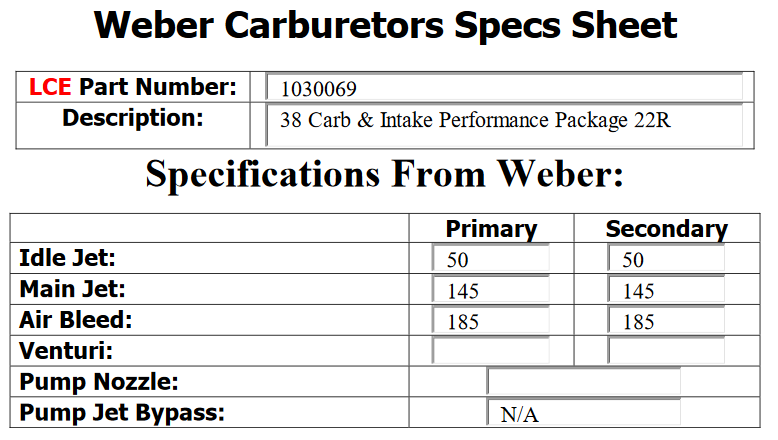
Weber Replacement & Optional Parts
Keep your Weber carburetor performing at its peak with our selection of genuine replacement components, tuning kits, and accessories:
- Jetting Gasket Kit: (Part# 1035026)
- Rebuild Kit: (Part# 1035024)
- Lean Jet Kit: (Part# 1035014)
- Rich Jet Kit: (Part# 1035006)
- Weber Foam Float: (Part# 1032037)
- Weber Carburetor Linkage: (Part# 1035021)
- Electric Choke (DGEV): (Part# 1035030)
- Weber Power Valve: (Part# 1035074)
- Fuel Pressure Regulator Kit: (Part# 1035056)
- Stock Replacement Air Cleaner: (Part# 1034036)