

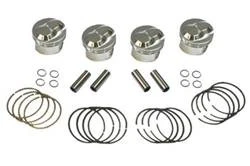
2RZ & 3RZ Pro Forged Piston Set | 10.0:1 Compression (+.020")
Bring race-proven technology to your Toyota 2RZ or 3RZ engine. Built on over a decade of success with our legendary 20R, 22R, and 22RE big-bore forged aluminum piston kits, these pistons are engineered to withstand the rigorous demands of high-RPM racing and heavy-duty performance use.
Kit Includes
- Premium Forged Aluminum Pistons
- Lightweight Tool-Steel Chromoly Wrist Pins
- High-Strength Spiral Locks
- Professional-Grade Performance Piston Ring Sets
Key Features & Specifications
- Engine Application: Toyota 2RZ (2.4L) / 3RZ=FE (2.7L) 16-Valve DOHC
- Bore Size: 95.50mm (+.020")
- Compression Ratio: High-performance 10.0:1 ratio-engineered to deliver optimal compression for naturally aspirated builds and high-response performance.
- Structural Integrity: Forged construction provides vastly superior tensile strength and resistance to detonation compared to factory cast or hypereutectic pistons.
Custom Machining & Installation Notes
- Custom Camshaft Valve Clearance: For builders running aggressive, high-lift, or high-duration aftermarket camshaft profiles, custom piston notching service is available to ensure adequate valve-to-piston clearance. Please see our Notch Labor service for more details or to add this machining service to your build.
- Bore Inspection: Your cylinder block must be precision bored and honed to exactly 95.50mm to achieve the critical piston-to-wall clearances required for high-performance forged alloys. Always provide these pistons to your automotive machinist prior to final block honing.
| Note: Images are for illustration purposes only. Images may not represent the product listed. Please contact customer service with any questions or concerns: 1-928-505-2501. |
- 1995.5-2004 3RZ 2.7L Engines
CP Forged Piston Set
Cylinder Honing Instructions (CPN & CPN2)
For engine builders using CP Pistons CPN and CPN2 piston rings, achieving the correct cylinder wall finish is critical to ensure rapid ring seating, optimal oil retention, and maximum compression sealing. When preparing a gray cast iron engine block or Nikasil cylinders, ensure your machine shop follows these precise specifications.
Key Specifications
- Ring Compatibility: CP Pistons CPN and CPN2 ring sets
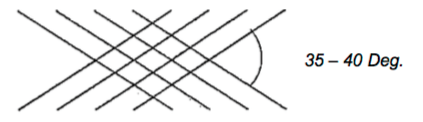
- Honing Method: Plateau Honing
- Cross-Hatch Angle: 35-40 degrees
Two-Stage Honing Process
1. Initial Honing Stage
Use either of the following stone types to establish the baseline cross-hatch pattern and target roughness.
- Conventional Stones: #220-#280 grit
- Diamond Stones: #325-#550 grit
2. Plateau Finishing Stage
After the initial hone, you must smooth the cylinder walls to eliminate jagged peaks, folded metal, and torn material. Finish the bores using one of these three methods.
- A fine-grit conventional abrasive (#400-#600 grit)
- A flexible honing brush sweep
- A nylon-bristle plateau honing tool
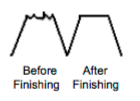
Technical Note: Always verify with your honing equipment manufacturer that your specific stone grits will accurately produce the required surface roughness targets:
- Rz Surface Finish: 59 - 138 μin (1.5 - 3.5 μm)
- Ra Surface Finish: 15- 35 μin (0.4 - 0.9 μm]
CP Piston Ring End Gap Recommendations
The guidelines provided below are general industry recommendations. The optimal rung gap varies depending on your specific engine configuration and application. Enhanced clearances are required for high-stress environments, including forced induction (turbocharged or supercharged), nitrous oxide systems, filled blocks, and endurance racing. Determining and verifying the final correct end gap is the sole responsibility of the engine builder.
For additional technical support, please contact customer service directly at 949-567-9000.
-Critical Safety Note: Failure to properly check and set the piston ring end gap can result in catastrophic engine failure.
How to Calculate Your Ring End Gap
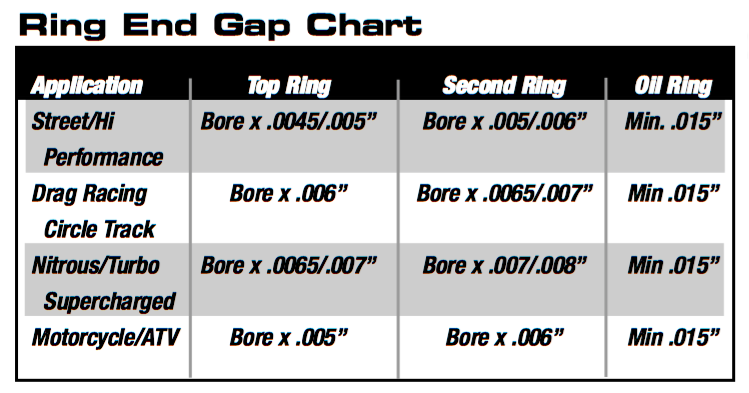
To calculate your required ring end gap, first locate your specific driving application in the target specification chart.
-Note: All metric cylinder bore measurements must be converted to inches before applying the gap factor.
Step-by-Step Calculation
- Convert Bore to Inches: Divide the metric bore size (mm) by 25.4.
- Apply Application Factor: Multiply the resulting bore size in inches by the specific application clearance factor provided in your spec sheet.
Example Calculation (81mm Bore for a Standard Street Application):
- Step 1: 81mm / 25.4 - 3.189 inches
- Step 2: 3.189 x 0.005 = 0.016" target end gap
Piston Ring Installation & Gap Measuring Procedures
The following instructions outline the standard procedures for verifying piston ring end gap. Because high-performance or specialized applications may require different clearances, always consult the included technical charts and diagrams before final installation.
Step-by-Step Ring Gap Measurement
Torque Plate Installation: If applicable to your engine build, install a torque plate onto the engine block and torque it to factory specifications to simulate true cylinder distortion during operation.
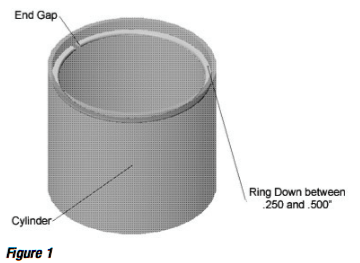
- Squaring the Ring: Insert the piston ring into the cylinder bore. Ensure the ring is positioned below the deck surface and completely square to the bore. (See Figure 1)
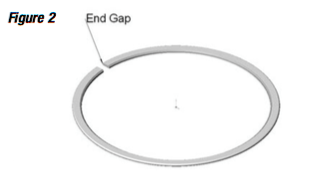
- Measuring the Gap: Use a precision feeler gauge (or an equivalent ring-gap measuring tool) to measure the distance between the ring ends. (See Figure 2)
-Important: If your measured ring gap is less than the minimum specification required for your specific bore size, it will be necessary to file-fit the rings to achieve the proper end gap. Failure to do so can cause the ring ends to butt together under thermal expansion, leading to severe engine damage.
Piston Ring Filing & Placement Procedures:
When file-fitting and preparing your piston rings, accuracy and correct orientation are critical to ensuring proper engine compression and preventing cylinder damage.
Step-by-Step Ring Filing Guidelines
- Use the Proper Equipment: Always use a dedicated manual or electric piston ring-gap filing tool. Do not use standard hand files or grinders.
- Filing Direction: Always file the ring end in an inward direction (from the outside face of the ring toward the inside). Filing outward can chip or damage the premium outer coatings.
- Keep it Square: Ensure the ring ends remain completely square and parallel to one another during the filing process.
-Bore Size Note: Performance ring sets are manufactured to precision tolerances for specific bore diameters. For every 0.001" the cylinder bore is oversized or worn beyond its intended specification, the ring end gap will naturally increase by 0.00314"
Top Compression Ring Installation & Orientation:
Before installing the top compression ring, closely inspect the ring faces and edges for any markings or bevels, then install according to these rules:
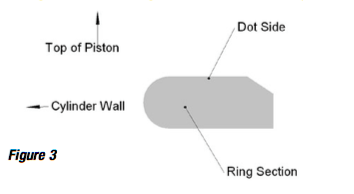
- Marked Rings: If the ring features a dot, laser etching, or writing, always install the ring with this marked side facing UP toward the cylinder head.
- Unmarked Rings with an Inner Bevel: If the ring is completely unmarked but features a cut bevel along the inside edge, install the ring with the bevel side facing UP toward the cylinder head.
- Completely Unmarked/Uniform Rings: If the ring has no dot, writing, or inner bevel, it is symmetrical and can be installed with either side facing up.
Second Compression Ring Installation & Orientation:
Before installing the second compression ring, carefully inspect the ring faces and edges for markings, grooves, or bevels. Proper orientation is essential to ensure effective oil control and prevent compression blow-by. Install the ring according to the following guidelines.
- Marked Rings: If the ring features a dot, laser etching, or writing, always install the ring with the marked side facing UP toward the cylinder head.
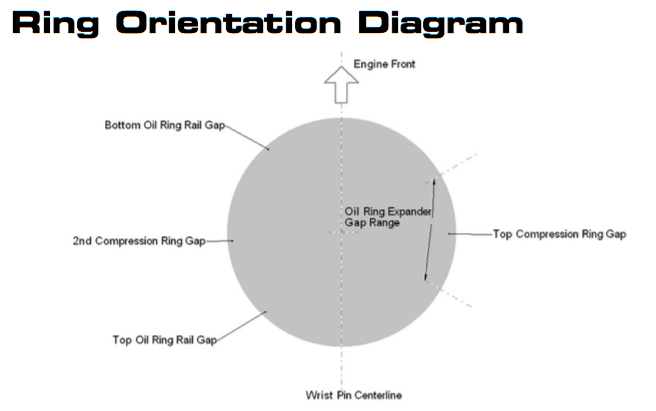
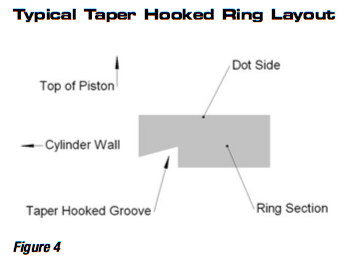
- Taper Hook Groove Style (Scraper Ring): If the ring features a taper hook groove along its outer edge, the groove must always face DOWN toward the oil pan. (See Figure 4)
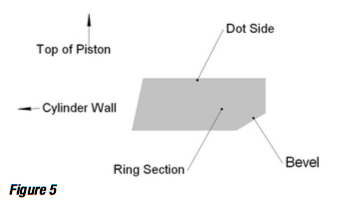
- Unmarked Rings with an Inner Bevel: If the ring is completely unmarked but features a cut bevel along the inside edge, install the ring with the bevel side facing DOWN toward the oil pan. (See Figure 5)
- Completely Unmarked/Uniform Rings: If the ring has no dot, writing, hook groove, or inner bevel, it is completely symmetrical and can be safely installed with either side facing up.
Oil Ring Installation & Specifications:
Most CP Pistons oil ring assemblies utilize a three-piece design consisting of two thin steel rails and a center expander ring. Proper installation is critical to ensure optimal oil control and prevent cylinder wall scoring.
- Rail End Gap Clearance: Ensure the end gaps on both the upper and lower oil rails are a minimum if 0.015".
- Rail Alignment: The ends of the rails must never butt together or overlap during installation.
- Expander Modification: Do not cut, file, or modify the center expander ring in any way. The expander relies entirely on its factory-engineered tension to properly support the rails and maintain correct tension against the cylinder wall.
Product Disclaimer & Limitation of Liability
Due to the extreme stresses and severe operating conditions inherent in high-performance and racing environments, all CP Pistons/Pankl products and services are sold strictly "as is" and "with all faults."
Exclusion of Warranties
There are no warranties, express or implied, given for these products. This includes any implied warranty of merchantability or fitness for a particular purpose.
As a core condition of doing business and part of the bargain of sale, the purchaser expressly agrees that they assume all risk. The purchaser takes full responsibility for selecting, testing, and verifying that the parts are appropriate for their specific application. CP Pistons/Pankl provides all buyers with a complete opportunity to inspect and examine all parts, inventory, and services prior to purchase and installation.
Limitation of Liability
Cp Pistons/Pankl shall not, under any circumstances, be held liable for any special, incidental, or consequential damages. This strict limitation of liability includes, but is not limited to:
- Damage to, or operational failure of, other engine components, property or equipment.
- Loss of anticipated profits, business revenue, or commercial opportunities.
- Costs associated with down-time, labor, or acquiring replacement goods.
- Third-party claims made against the purchaser by their own customers.
- These liability exclusions apply absolutely to any and all outcomes resulting from the sale, installation, modification, or track use of these high-performance parts.


