Why This Page Exists
Head gasket failure is the single most common problem on the 1985-1995 22R and 22RE, and there is a design reason for it: a cast iron block with an aluminium cylinder head. The two metals expand and contract at different rates, add heat and time, and the joint between them is where it shows.
Which is why it is worth doing properly once rather than twice.
Head Gaskets: Two Numbers, Not One
Choosing a head gasket takes two measurements rather than one:
- Bore. The gasket has to clear your bore — standard, +.040", +.080" and so on.
- Thickness. This is the one people miss. Gasket thickness changes deck clearance and therefore changes your compression ratio. If you have chosen pistons for a target ratio, the gasket is part of that calculation, not an afterthought.
MLS — and why we stock so many
Multi-Layer Steel gaskets were developed in Japan in the early 1990s and remain the industry's preferred head sealing method — roughly 80% of new engines are designed around them. They came after copper and brass, after metal-and-asbestos, and after the composite fibre and graphite gaskets of the 1980s, and nothing has displaced them since.
Ours are listed as bore × thickness, so you can hit a compression target precisely:
Composite and OEM
OEM head gasket · Street, up to .060" over · Pro, up to .080" over · Thick (+.020", .073" overall).
The Street gasket is our most popular for the 22 series — carbon composite and stainless, good for stock bore up to .060" over, and fine on a stock turbo engine. The Pro is the same idea in a carbon composite built for a high-performance engine.
The thick gasket is the one to reach for when you need to drop compression — a boosted engine, or a block that has been decked.
If the head has been milled hard
A head that has been skimmed past factory spec loses compression height and pulls the cam centreline closer to the crank, which is where mysterious timing chain slack comes from. The +.020" steel head shim puts both back where they belong. If your machinist has taken a lot off, ask about this before you assemble.
Gasket Sets
Head gasket sets by year: 1985-1995, 1983-1984, 1981-1982, plus the OEM sets for 1989-1995 and 1985-1988 Pickup and 4Runner.
Complete sets: 1985-1995, 1981-1984, and OEM for 1989-1995 and 1985-1988.
Bottom end only — oil pan gasket, front and rear crankshaft seals and the timing cover gasket: 1985-1995 and 1981-1984.
One thing about the complete set that catches people out. A genuine 22R/RE seals the oil pan with silicone, not a gasket — so the complete kit contains no oil pan gasket and no silicone. Buy the sealant separately. Early engines that did use a pan gasket take the 1975-1984 oil pan gasket. Also worth noting: gasket kits are sealed and non-returnable once opened, so confirm the year before you open the bag.
Intake side: the intake manifold gasket set.
Rear Main — Do It While the Gearbox Is Out
This is the leak that is cheap to fix at the wrong time and expensive at every other time. The rear main seal, the housing gasket and the rear seal gasket assembly.
If the crank has a wear groove where the old seal rode, a new seal alone will leak again. The Seal Saver gives it a fresh surface to run on — which is why it is included in the Pro Clutch and Flywheel bundle. There is a matching one for the front balancer seal as well.
Valve Seals — Match Them to the Guides
Viton seals come in two versions and they are not interchangeable: for stock guides and for Pro bronze guides. If you fitted our bronze guides, take the second one.
Intake, Exhaust and EGR
The Teflon heat isolation intake gasket reduces heat transfer from the head into the intake, which is worth having on a carbureted engine in hot weather. Also the LCE EGR crossover gasket, the OEM version and the air injection gasket.
Head Bolts or Head Studs?
Bolts are fine for a stock or mild rebuild and they are what the engine was designed around: OEM 1985-1995, OE 1985-1995 and OEM 1975-1984.
Studs clamp more evenly and hold better under boost or high compression, and they make head removal easier next time: the Pro head stud kit. In the bottom end, the Pro main stud set.
Head bolts are torque-to-yield — do not reuse them. If the head is coming off, the bolts are part of the job.
Small Parts That Stop a Rebuild
The brass freeze plug set of 6 — brass rather than steel because it will not rust out again — and the dowel pin that aligns the head to the block.
Brass matters here rather than being a nicety — zinc-coated plugs weep and steel ones rust. Brass does neither, which is why any engine builder uses them regardless of the application.
Oil drain plug gaskets in small and large, and the rocker arm assembly locator ring dowel.
The Oil Galley Plugs — and Why They Catch People Out
Every 20R/22R block and crankshaft has oil passages that were drilled at the factory and then plugged. To clean a block or a crank properly those plugs have to come out, and they do not go back in.
They are British thread. BSPT, not NPT and not metric — which is why the local hardware store cannot help you and why being one short with a block at the machine shop costs a week.
The complete rebuild galley plug kit is the easy answer. Individually, and here are the quantities you actually need: small, 1/8"-28 BSPT — two, passenger side of the block. Medium, 1/4"-19 BSPT — four for the crankshaft and one inside the block under the oil filter. Large, 3/8"-19 BSPT — front of the block and rear.
Worth knowing which way round it arrives: our blocks ship with the plugs installed; crankshafts ship with them out, because that is how they get cleaned.
Sealant
Valve covers, oil pans, intake manifold end seals, timing covers, water pumps and thermostat housings on this engine are sealed with RTV rather than a gasket. Two options, both OEM specified: Toyota Seal Packing 103 (FIPG), part 00295-00103, which is what the factory manual calls for on the oil pan and camshaft housing; or Ultra Grey, rated -65°F to 500°F and made for high-torque, high-vibration engines. Either will do the job. Neither will save a surface that was not cleaned.
Buy the freeze plugs, the dowel pin and the sealant with the gasket set. They cost very little and being without one on a Sunday afternoon stops the whole job.

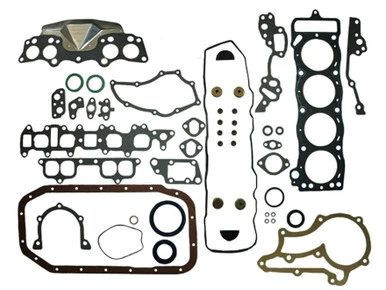
 Bottom End Gasket Set Gasket set for the lower half of the engine block. Includes new oil pan gasket, front and rear crankshaft seals, and the timing cover gasket. Contact our Tech Support...$66.89
 OEM Head Gasket LC Engineering carries a complete line of Head Gaskets for all types of applications. This is an OEM Toyota head gasket for most 22 engines; it is a high-quality carbon composite...$59.90
 Bottom End Gasket Set Gasket set for the lower half of the engine block. Includes new oil pan gasket, front and rear crankshaft seals, and the timing cover gasket. Contact our Tech Support...$51.52
 Intake Manifold Gaskets (Teflon / EFi) Teflon Heat Isolator kits keep the power-robbing heat away from the intake air. By keeping the heat out of the intake manifold, the incoming air is cooler,...$45.40
 Pro Head Gasket (Up To .080" Over) LC Engineering carries a complete line of Head Gaskets for all types of applications. Whether you need a stock replacement head gasket for your rebuild or a more...$45.11
 Thick Head Gasket (+.020" / .060" Over Bore) For heads that have been milled beyond factory spec, we offer an extra-thick head gasket to bring the compression ratio back to where it should be. This...$44.56
 Street Head Gasket (Up To .060" Over) LC Engineering carries a complete line of Head Gaskets for all types of applications. This is our most popular head gaskets for most 22 engines; it is a...$43.24
 Pro Header Gasket Set Complete gasket set for the proper installation of our headers. Pro header gasket kits come with a two-bolt OE collector gasket to match the collector on our Pro Header. Kit...$39.72
 Pro Header Gasket Set Complete gasket set for the proper installation of our headers. Pro header gasket kits come with a two-bolt OE collector gasket to match the collector on our Pro Header. Kit...$39.72
 Valve Cover Gasket Set These valve cover gaskets feature precision edge-molded silicone rubber, which resists high heat and delivers reliable sealing on irregular surfaces. This silicone rubber is...$38.69
 Harmonic Balancer Seal Saver Do you have a pesky oil leak coming from the harmonic balancer? Don't just keep swapping out front seals. Press this seal saver into the harmonic balancer seal surface...$38.07