Radiators: Three Levels
The 22R is not a hot engine by nature, but a thirty-year-old radiator with a partly blocked core is, and it usually shows up first as creeping temperatures on a long climb or with a trailer on.
- Heavy Duty radiator with cap — 1986-1995 Pickup and 84-88 / 92-95 4Runner. All metal, three rows, no plastic tanks to crack, and it sits flush with the factory radiator support. The straightforward upgrade over a tired original.
- Modified Heavy Duty — same copper and brass three-row core, modified for the Black Magic electric fan kit. Take this one if you are going electric; it also works with a flex fan.
- Koyorad all-aluminium racing radiator — 1984-1995 Pickup and 4Runner, manual transmission. Koyorad's HH Series 48mm core, more coolant volume, and it bolts to the factory fan shroud. For built engines, boost, or sustained hard use.
Also: the all-metal radiator without cap if you are keeping your own, the Heavy Duty radiator for the 1985-1987 22RTE, and for the Celica the Koyorad for the 1976-1977 20R.
Caps are not interchangeable and they are not an afterthought — the cap sets system pressure, which sets the boiling point. Toyota used two sizes and you need the right one: small 1 3/4" (Sankei OEM-style, stainless, 13 lb / 0.9 kg/cm²) or large 2 1/4". For racing, the Koyorad high-pressure cap.
Water Pumps
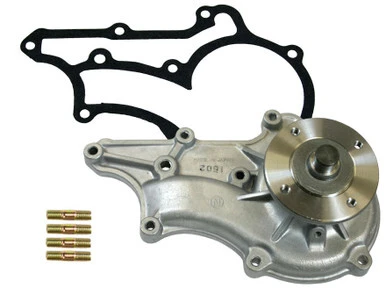
New OEM-quality Japanese pumps, and the gasket comes with the pump. Split at 1984: 1985-1995 22R/22RE and 20R 9/77-80 or 22R 81-84. Spare gaskets follow the same split — 1985-1995, the OEM version, and 1975-1984.
Two things to know before you order. These pumps do not fit dual row timing chain conversions — if you have run our dual row conversion kit, call us. And the most common cause of a short water pump life is an over-tightened V-belt, not the pump. If you have killed one early, check the belt tension before you fit the next.
Change the pump whenever the timing cover is off. It is a few dollars against the labour of going back in, and it is why our Premium rebuild kit and the dual row conversion kit both include one.
Thermostats: Pick the Temperature Deliberately
Colder is not better. A thermostat that is too cold keeps the engine out of its designed operating range, which costs you fuel economy and, on an EFI truck, can keep it running rich.
- OEM 190°F / 88°C, 1980-1995 — genuine Toyota, part 90916-03078. The correct default for a street truck.
- 2-stage OEM 190° — worth understanding. The factory 195° unit simply cycles fully open and fully shut, which swings the temperature either side of where you want it. The two-stage has a second valve, so it meters coolant rather than switching it, and holds a steadier temperature. Steadier temperature means a denser charge and an engine that runs where it was designed to.
- 190° · 180° · 160° — the cooler options for desert heat, towing or a built engine.
Housing gaskets are style-specific: round rubber or flat paper. A complete OEM thermostat housing if yours is corroded, and if you are fitting a late water neck to an early engine, the housing adapter kit.
Hoses — Replace Them All at Once
Silicone kits are three-ply polyester reinforced and rated from -20°F to 350°F, so they do not go soft in engine bay heat the way a thirty-year-old rubber hose has. Order by model and year:
Pickup: radiator and heater 1989-1995, radiator 1984-1995, heater 1989-1995, heater 1984-1988. In colour: blue radiator+heater 89-95, blue radiator 84-95, red heater 89-95, red heater 84-88, blue heater 84-88.
4Runner: radiator and heater 1989-1995, radiator 1984-1995, heater 1989-1995, heater 1984-1988.
Trail-Gear silicone radiator hose kits: 22R/RE and 22RE. And while you have it apart, the 22RE silicone vacuum hose kit in your choice of colour, or in black or blue. Cracked vacuum lines are behind a lot of idle and drivability complaints on a 22RE.
Hard parts in the coolant path, all easy to overlook and all prone to corroding through: the radiator pipe, the radiator outlet hose, the coolant bypass pipe, the bypass union elbow, the heater water outlet pipe and the o-ring for the heater tube under the EFI manifold.
Correct clamps matter more than they look: the coolant bypass clamp, the water bypass clamp, the radiator inlet clamp, bolt-style clamps for outlets 1 and 2 or just outlet 2, and the OEM vent hose spring clamp.
Coolant: Conventional or Waterless
Evans waterless coolant removes water from the system entirely, which raises the boiling point and takes localised boiling — the hot spots that crack heads — off the table. It is a real option on a hard-worked or boosted 22R.
It is not a drain-and-fill, and this is the part to get right: you must flush the system completely and then run Evans Prep Fluid to get every trace of water out. Skipping that can damage the engine, and you never add water afterwards.
Evans High Performance Waterless Coolant · Prep Fluid · Prep Fluid, half gallon · refractometer to confirm you got the water out.
Fans and Shrouds
Three approaches, and the right one depends on how the truck is used.
- Stock mechanical — the Aisin fan blade and the Aisin fan clutch. Reliable, no wiring, always turning. A tired fan clutch is a common and easily missed cause of high temperatures.
- Flex fan — maximum airflow at low rpm, blades flatten at speed so the engine is not fighting the fan on the highway. The 15" flex fan, the flex fan with billet spacer kit, the 3" billet spacer kit on its own (CNC machined here, and it is what clears the accessory pulleys and puts the fan in the right place in the factory shroud), or the lightweight plastic flex fan for circle track. Say it plainly: flex fans are louder than a stock fan. That is how they work, not a fault. They also need a shroud and a spacer.
- Electric — the Black Magic S-Blade fan kit: 3,000 CFM, 19.5 amp draw, with an adjustable thermostat (180-240°) and an A/C relay included. Also the electric fan kit for 1975-1983 Pickup and Celica, a 14" universal fan, a S-Blade replacement blade and a straight replacement blade. Frees up power and cools at idle — worth most on a crawler that spends time barely moving.
Wiring and control: an adjustable relay set with sensor, a Black Magic adjustable temperature sensor, an illuminated manual switch — worth having for water crossings and mud, where you want the fan off — and a universal bracket set.
Shrouds do half the work. A fan without a shroud pulls air from around the radiator rather than through it. The OEM lower fan shroud, 1982-1995, the 1988-1995 lower shroud and the shroud clips.
Belts and Pulleys
Belts: fan and alternator, power steering and A/C idler, plus the A/C and power steering idler pulley. Standard water pump pulleys in billet stock size 4 3/4".
Underdrive pulleys — read this before you buy
Underdrive pulleys slow the water pump and alternator, which reclaims a little power and, on a high-rpm engine, stops the water pump cavitating. They also cut a lot of weight: the factory steel harmonic damper is around 5 lb and over 6" across; the billet replacements are 0.5 to 1.5 lb at 4". The crank pulley kit has a degree wheel machined into it, so you can find TDC and time the engine off the pulley itself.
The trade-off is the part nobody mentions, so we will: these replace the harmonic balancer, and they are designed for high-rpm race engines. A balancer exists to damp crankshaft torsional vibration on a street engine that idles and lugs. If your truck is a daily driver or a crawler, the factory replacement harmonic balancer is the right part and an underdrive pulley is not.
Crank pulleys: 4" single groove · 4" double groove · 4" triple groove. Water pump pulleys: 6" and 7" black anodised billet. Or the complete underdrive pulley kit with the 7" water pump pulley.
The belt is specific to the kit. Check which you have: Street 6" kit, Pro 7" kit without alternator or Pro 7" kit with alternator. Match pulleys as a set rather than mixing sizes.
Block Plates
Coolant passage plates, easy to reach with the engine apart and miserable later: Pro water block plate kit — centre-of-head plate (which is what an Offenhauser manifold needs) plus both plates behind the water pump, with bolts and washers. Note it removes the coolant supply to your heater core, so it is a race and off-road part unless you never use the heater.
Individually: driver side, passenger side, centre of head, and under the intake in 8 bolt or 11 bolt.
If It Is Still Running Hot
Temperature gauge reading high but the system is healthy? Check the sender before you condemn the engine — coolant temperature sensors and gauge senders are on our 22R sensors and electrical page. And if the head gasket is the reason it is hot, that is on the gaskets and seals page.

 Black Magic Electric Fan Kit 84-95 22R/RE Pickup/4RNR & All 3VZ (S-Blade) The Flexalite Fan pulls more air than the regular Black Magic Electric Fan without the new S Blade design. All Black Magic...$541.58
 HD Radiator w/ Cap Put excess engine heat on the back burner of your Toyota with these Heavy Duty Toyota radiators. The heavy duty make of these Toyota radiators makes them capable of keeping ...$513.66
 HD Radiator (Modified) Put excess engine heat on the back burner of your Toyota with these Heavy Duty Toyota radiators. The heavy duty make of these Toyota radiators makes them capable of keeping...$492.70
 Koyorad Racing Radiator (Aluminum) Koyorad announces the latest addition to their Japanese Classic radiator line with a direct replacement all-aluminum performance radiator for popular 4 Cylinder...$429.92
 HD Radiator w/ Cap Put excess engine heat on the back burner of your Toyota with the Heavy Duty Toyota radiators that LC Engineering sells. The heavy duty make of these Toyota radiators makes them...$400.14
 Single Row Timing Chain Kit (w/ Metal Guides & Pumps) LC Engineering has expanded its line of Metal Back Guides to include them in a complete timing set. This is perfect for someone reconditioning...$334.96
 HPS Silicone Radiator & Heater Hose Kit (Blue) This brand new HPS High Temp 3-ply Reinforced Blue Silicone Radiator + Heater Hose Kit for Toyota 89-95 Pickup 22RE Non Turbo EFI Left Hand Drive is...$313.00
 HPS Silicone Radiator & Heater Hose Kit (Black / Red / Blue) This brand new HPS High Temp 3-ply Reinforced Silicone Radiator + Heater Hose Kit for Toyota 89-95 4Runner 22RE Non Turbo EFI Left Hand...$260.54
 HPS Silicone Radiator & Heater Hose Kit (Black / Red / Blue) This brand new HPS High Temp 3-ply Reinforced Silicone Radiator + Heater Hose Kit for Toyota 89-95 Pickup 22RE Non Turbo EFI Left Hand...$260.54
 High-Performance Billet Underdrive Pulley Kit High-RPM race engines often overdrive the water pump, leading to cooling system cavitation and inefficiency. Our Billet Aluminum Underdrive Pulleys...$242.31
 Electric Fan Kit Do you own an early model (75-83) Celica or Pickup? Tired of being told that there is no direct fit electric fan kit for it? Well LC Engineering decided to do something about it...$235.61
 HPS Silicone Radiator Hose Kit (Blue) Toyota 84-95 Pickup 22RE Non Turbo EFI HPS High Temp 3-ply Reinforced Silicone Radiator Hose Kit Blue is designed to replace stock OEM rubber hoses which can...$200.00