Throttle Position Sensors: Five Versions, Very Narrow Windows
The TPS changed more often than almost any other part on the 22RE, and the fitment windows are months rather than years. Read them carefully:
A new TPS is not a fitted TPS. These have to be adjusted correctly on installation, and a sensor that is merely bolted on will give you hesitation, poor idle and bad fuel economy just as convincingly as the failed one you replaced. If you are not confident setting it, ask us for the adjustment procedure before you start.
Connectors: the 1984-1988 plug with wires. The TPS allen bolt upgrade kit replaces the factory screws, which round off the first time anyone tries to adjust them.
Starters
Hard starting, or a click and nothing, is often the starter rather than the battery. Our Hi-Torque starters are built to OE specification for fit and function, and no core is required — you are not sending anything back.
1981-1991 4Runner and Pickup · 1989 - July 1993 · August 1993 - 1995
Note the mid-1993 split — a 1993 truck could be either, so check the build date rather than the model year.
Charging
Stock alternators were sized for a truck with no winch, no light bar and no fridge. If you have added any of that, the direct fit high output alternator for 1985-1995 lets you choose the output and bolts straight in, keeping the factory plug and your dash charge light. It is US models only.
One honest limitation. It does not make more amperage at idle — the extra output arrives as rpm rises. If your problem is winching or running lights with the engine idling, that is a battery and wiring question, not an alternator one.
Running a GM one-wire alternator instead — a common swap on older and converted trucks — needs the GM 1 wire alternator bracket kit: a true bolt-on with no major modification, and it keeps the stock alternator belt.
Belts: the fan and alternator belt, and if you are running our underdrive pulleys, the Pro 7" underdrive belt with alternator.
Temperature and Oil Pressure
Two different jobs share this section, and they are easy to confuse: a sensor tells the ECU what to do, a sender drives the gauge on your dash. Replacing the wrong one fixes nothing.
Coolant temperature sensors (to the ECU): 1989-1995 and 1984-1988. A failing one makes the truck run rich, start badly when warm and drink fuel — it is worth suspecting early.
Temperature gauge senders (to the dash): 1993-1995 and 1984-1989.
Oil pressure: the oil pressure light switch 1984-1995, and for trucks with the real gauge, the SR5-only senders for 1993-1995 and 1985-1992.
Oxygen Sensor
The heated universal 4-wire oxygen sensor with its 2-bolt gasket. A lazy O2 sensor will not always light the check engine lamp but it will quietly cost you several miles per gallon — on a 22RE that has done 200,000 miles, assume it is due.
Engine Management and Gauges
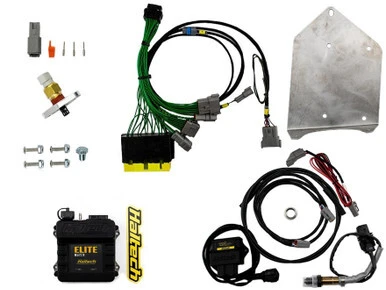
If you are running standalone management — which our turbo kits require — the Haltech iC-7 colour display dash replaces the factory instruments with something that shows what a boosted engine is actually doing.
Mounting, because the iC-7 has to go somewhere sensible: standard dash bracket, moulded dash panel mount, bracket with integrated sun visor and the 1.25" tube mount for a cage or bar.
For a single reading rather than a full dash, the Haltech multi-function CAN gauge, 52mm.
Fuel pressure gauges, which matter most on a converted or boosted engine where you are no longer running the factory regulator: the GlowShift 30 psi electronic gauge for the 20R/22R, the 30 psi kit, and the 100 psi version for EFI pressures.
Also here: the Pro Fuel 22RE hall sensor mount and the 1981-1983 catalytic converter with thermal sensor.
Propane Injection
Less common, and worth knowing we carry it: propane injection kits for the carbureted 20R/22R and the 22RE. Mostly of interest where fuel quality is unreliable or where a dual-fuel setup makes sense for the way the truck is used.
Where to Start When It Runs Badly
On a fuel-injected 22R the usual order is: check for vacuum leaks, then the TPS adjustment, then the coolant temperature sensor, then the oxygen sensor. Three of those four are on this page and none of them is expensive. Ignition parts — distributor, plug wires, coil and tune-up kits — are worth ruling out alongside them.


 Haltech Multi-Function CAN Gauge | 52mm (2") Digital OLED Display Streamline your dashboard and monitor your engine with total precision using the Haltech Multi-Function CAN Gauge. This 52mm (2")...$431.57
 Direct Fit High Output Alternator (U.S. Models ONLY) LC Engineering's Direct Fit high output alternator is the answer to all your charging issues. Running big off-road lights, killer stereo or a...$381.05 - $511.05
 Catalytic Converter This is for the Early pickups that have a small pipe that comes off the catalytic converter. This cat will be 16 3/4" long with 2" flanges on both ends. While the majority of...$346.08