Choose by What the Truck Does, Not by the Number
Stage numbers look like a ladder where higher is better. They are not. A higher stage moves the power band up the rev range, and if your truck does not live up there, you have made it slower everywhere you actually drive.
These are twin-cam sets — intake and exhaust together — and the whole range is ground by us.
Stage 1 — stock or mildly built, factory computer
The right choice for the large majority of 3RZ owners. It suits a stock or lightly modified engine and runs on the factory ECU with no tuning required. It will also work on a low boost application at 4-10 psi if you want a little more out of a supercharged truck. If you drive your Tacoma, start here.
A dramatic increase in mid-range horsepower and torque, which is the part of the rev range a truck spends its life in. Designed for a well built naturally aspirated engine — this is the point where the rest of the engine needs to be up to it.
Both move the power decisively into the upper rpm range. They work in off-road racing, circle track, drag racing and hot street use. On a truck that tows or crawls, they will feel worse than stock below 3,000 rpm.
Stage 5 — competition only
Huge lift and huge power, used in short course off-road, drag and circle track. Not a street camshaft, and not something to fit to an engine that has not been built for it.
Boost changes the answer
A turbocharged engine wants a different profile. The Stage 3 Turbo (3,000-8,500 rpm, 4-20 psi) and Stage 5 Turbo (4,500-9,500 rpm, 20-40 psi) are on the Turbo Kits & Parts page.
Adjustable Cam Gears — More Necessary Than You Think
The adjustable cam gear fits the intake cam, and on the 20R, 22R, 2RZ and 3RZ it is the only accurate way to change cam timing at all.
The usual reason is not tuning — it is correction. Milling the cylinder head or decking the block moves the camshaft closer to the crank and retards the cam timing. If you have had machine work done and not corrected for it, the engine is not running the timing the camshaft was ground for, and you will never see what you paid for.
It is also how you dial a camshaft in properly by advancing or retarding it to suit the rest of the combination.
If you fit one, replace the intake cam hub bolt. It is a seven-dollar part and we recommend replacing it any time the stock cam gear comes off.
Do Not Fit a Camshaft Alone
A camshaft is a valve train component before it is a power part. At Stage 2 and above, the springs, retainers and followers have to be able to control the valve at the lift and rpm the new cam asks for. Fit a big cam on tired factory springs and you will float valves and damage the head.
The full range — Street Performer, dual and Pro HD dual spring sets, titanium retainers, cam followers and complete valve train kits — is on Cylinder Heads & Valvetrain.
What We Would Fit
- Daily driven Tacoma, factory ECU — Stage 1, and nothing else needed.
- Built naturally aspirated street or trail engine — Stage 2, with a valve train kit.
- Off-road racing, circle track, drag — Stage 3 or 4, valve train kit, and a conversation about gearing.
- Competition only — Stage 5, built engine, no compromises.
- Supercharged at low boost — Stage 1 works well and keeps the factory drivability.
- Turbocharged — use the turbo grinds, not these.
Full duration, lift, centreline and valve clearance figures are published on each camshaft's product page. Not sure which one suits your build? Tell us the engine, the gearing and what the truck does and we will pick it with you.

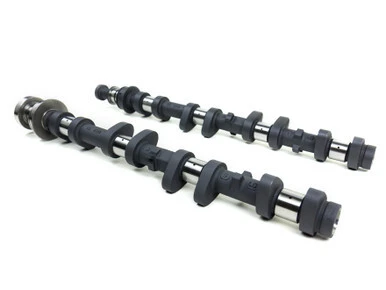

 Stage 1 LC Engineering has the largest selection of Toyota cams anywhere which means that no matter what application you have we can get the right cam for you. The 2RZ/3RZ Pro Camshaft Set is the...$965.91
 Stage-2 LC Engineering has the largest selection of Toyota cams anywhere which means that no matter what application you have we can get the right cam for you. The 2RZ/3RZ Stage 2 Camshaft Set...$937.78
 Stage 5 (Turbo) LC Engineering has the largest selection of Toyota cams anywhere which means that no matter what application you have we can get the right cam for you. With power potential over...$937.78
 2RZ/3RZ Stage 3 Turbo Camshaft Set LC Engineering has the largest selection of Toyota cams anywhere which means that no matter what application you have we can get the right cam for you. The...$937.78
 Stage-4 LC Engineering has the largest selection of Toyota cams anywhere which means that no matter what application you have we can get the right cam for you. The 2RZ/3RZ Stage 4 Camshaft Set...$901.71
 Stage-5 LC Engineering has the largest selection of Toyota cams anywhere which means that no matter what application you have we can get the right cam for you. The 2RZ/3RZ Stage 5 Camshaft Set is...$901.71
 2RZ/3RZ - Stage 3 Camshaft Set LC Engineering has the largest selection of Toyota cams anywhere which means that no matter what application you have we can get the right cam for you. The 2RZ/3RZ...$901.71