
There are no products listed under this category.
-
fast shipping
Speed Delivery
There are no products listed under this category.
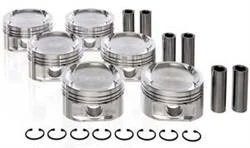
Everything else on this page follows from one number, and getting it wrong is the most expensive mistake in an engine build. Four forged sets, four different engines:
Fitting high compression pistons and then adding a supercharger is how engines get destroyed. Decide which engine you are building before you order, because the piston is the part you cannot change your mind about later.
For a rebuild rather than a race build, the Street Performer sets come complete with rings in STD, +.020", +.030" and +.040". Matching Hastings ring sets are sold separately in the same four sizes.
Measure the bores before you order. A set of pistons is the wrong thing to guess at.
The Pro Chromoly Crossbeam rod set is a set of six, custom made, fully balanced with bronze pin bushings and ARP rod bolts.
The honest guidance: the factory 5VZ rod is good to a surprisingly high power level. Upgrade rods when you are running serious boost or serious rpm, not as a default line item. For a stock rebuild the OEM rod bolt set and street rod bushing set of 6 are the correct parts — and the bolts are replace-on-assembly, not reusable.
Standard main, rod and thrust sets cover a normal rebuild.
The main bolt set of 8 is right for a stock engine. The Pro main stud set clamps the caps more evenly and belongs in anything seeing boost or high rpm.
Also here while the block is bare: brass freeze plugs — eleven of them on this engine, and a sensible upgrade over steel — and the crankshaft key.
The elastomer in the factory balancer deteriorates with age, which costs performance and lets vibration through to the crank. The replacement harmonic balancer is the fix, with the OEM front balancer bolt to go with it.
The lightweight crankshaft pulley is a different part for a different purpose — reduced rotating mass at the nose of the crank.
The usual cause is a groove worn into the sealing surface by the old seal, and a new seal riding in that groove leaks immediately. Seal Savers are repair sleeves that give the seal a fresh surface, front and rear.
On this engine the front seal matters more than on a chain engine. The front crankshaft seal sits directly behind the timing belt, and oil from a weeping seal will destroy a rubber belt. See Timing Belt Components.
Specifying a bottom end? Tell us the power target, the fuel and what the truck does and we will put the combination together with you.