Start With the Year — the Distributor Changed Four Times
More returns come off this page from year mismatches than from anything else. The distributor splits carbureted from injected, and then splits the injected trucks again:
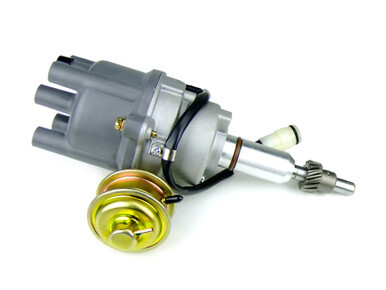
These are complete new units — new cap, new rotor, new electronics — and they come in under the OEM price. That matters because rebuilding a distributor properly needs specialised tooling; it is not a driveway job. Replacing the whole unit is usually the faster and cheaper way back to a truck that starts.
Caps on their own follow the same split: 1981-1992 and 1993-1995. The shaft O-ring and cap O-ring are the two parts people forget and then chase an oil weep over.
LCE Pro Distributor — a Re-Curved Advance, Not Just a New Unit
The Pro is our own build and the difference is inside it. Each one starts as a brand new distributor and gets custom springs and weights, then we re-curve the advance so it comes in quicker than stock. That is what you feel: throttle response off idle and through the mid-range, on an engine that is otherwise unchanged.
An old, worn distributor does the opposite — it drifts, it scatters the timing, and it quietly costs you power you have already paid for. If you cannot remember the last time the timing was checked, this is the part to look at first.
Pro with vacuum advance · Pro without vacuum advance, plus the Pro cap (1980-1992) and Pro rotor (1980-1995).
Vacuum advance or not?
Keep it on a street truck. Vacuum advance is what gives you part-throttle efficiency and drivability, and deleting it on a daily driver costs you fuel economy for nothing. Delete it on a race engine, or where a carburetor conversion has left you without a suitable vacuum source, so you have complete control over the curve. If you are not sure, take the vacuum advance version.
D.U.I. — the Race Option
We also carry the D.U.I. (Davis Unified Ignition) from Performance Distributors for the carbureted 20R and 22R. It is a one-piece system: the high voltage coil and high dwell module live inside the distributor, so it needs one 12-volt hot wire and nothing else — no external coil, no separate module, no loom to chase.
The high output coil and Dyna Mod module let you open spark plug gaps to .055", which puts more spark energy into the chamber. The version without vacuum advance is a true race distributor — different cams inside the housing, different weights and springs.
With vacuum advance · Without vacuum advance · Short body, with vacuum advance · Short body, without — take a short body if hood or firewall clearance is tight.
Service parts: D.U.I. rotor and the race cap and rotor kit.
Already have an HEI-style setup? The D.U.I. coil kits fit all internal HEI coil applications and come with a brass terminal cap, rotor and nylon hold-down screws. The Street/Strip kit fires to 7,000 rpm; the Race kit to 9,000. Both let you open the gap to .050-.055".
Which one, honestly
For a street or trail 22R, the LCE Pro is the one we build and the one we would fit — the re-curved advance is the part that changes how the truck drives, and it keeps the factory ignition architecture you already know. The D.U.I. earns its place on a race engine, or on a truck where reducing the ignition to a single wire is worth more than keeping it stock.
Drive Components
The distributor drive gear bolts to the front of the cam gear and is what turns the distributor. There is a fitment trap here worth reading twice: it needs either a mechanical fuel pump eccentric, or — if you have gone to an electric fuel pump — the drive gear spacer. Fit the gear with neither and the geometry is wrong.
Also here: the OEM hold-down bolt, the Pro Fuel distributor plug for engines converted to our Pro Fuel Injection, and the fuel pump eccentric itself.
Plug Wires: Match the Diameter to the Year
The 1978-1992 trucks take 7mm wires; the 1993-1995 trucks take 5mm. That is the split to get right in the OEM-replacement sets.
Pro wires — Magnecor KV85
Our Pro sets are Magnecor KV85 8.5mm competition cable. The conductor is 2.5mm of stainless steel wire wound at 200 turns per inch over a ferromagnetic core, which suppresses EMI — that is what keeps an aftermarket ignition from upsetting an EFI ECU. The jacket is single-layer aerospace-grade silicone rated to 600°F in service, and single-layer construction is deliberate: it conducts heat away from a hot spot instead of trapping it.
On a 22R with a header two inches from the wires, that is the specification that matters.
Pro 8.5mm 1978-1992 · Pro 8.5mm 1993-1995 · Pro set for the LC Pro Fuel kit (22RE). And the 11mm Livewire set, sleeved in heat-treated glass braid and pre-numbered at both ends so you cannot get the firing order wrong.
Keep them off the header
A melted plug wire is a roadside problem that costs a few dollars to prevent. Billet looms let you route above or below the loom as clearance allows — 8.5mm Pro wire loom and 11mm Livewire loom kit. Neither fits the 22RTE.
Separators on their own: billet separator kit, for 8.5mm Pro wires in standard or black, and for 11mm Livewires in black, red or blue. Plus the 1993-1995 factory wire clip.
Spark Plugs — and What Boost Does to the Heat Range
For a stock or mildly built engine, the NGK V-Power plugs are the sensible choice. The V-groove puts the spark at the edge of the centre electrode rather than in the middle of it, which lowers the voltage the ignition has to produce and resists fouling.
NGK BKR5EYA · NGK BKR6EYA (one step colder). Platinum: BKR5EGP G-Power · BPR5EGP G-Power.
If you are running boost or high compression, the plug has to come down in heat range as cylinder pressure goes up. This is the single most common way a healthy turbo 22R ends up with a hole in a piston, and it is entirely avoidable. Pick by what the engine is actually doing:
Coils and Ignition Boxes
The FAST I91 inductive E-core coil delivers up to 70% more energy at the plug than stock. The closed magnetic path cuts leakage inductance, and it is solid epoxy encapsulated, which is why it holds up to the shock and vibration an off-road truck puts through it.
Also here: the MSD Blaster 2 coil, the MSD 6AL digital ignition with rev control, the MSD ignition kit, and the MSD tachometer adapter — needed because a factory tach often will not read correctly off a capacitive discharge box.
Adapters for mixing systems: the HEI-style coil wire adapter, the FAST-to-stock-distributor coil wire and the 1993-1995 coil to LC Pro cap wire.
Tune-Up Kits — Cheapest Real Gain on the Truck
If the truck runs rough, hesitates or starts badly, do the whole ignition at once rather than one part at a time. Half a tune-up usually leaves the fault in place and the money spent.
Two things worth knowing before you order. The Pro kits are year-specific and the plugs come in several heat ranges — tell us the year and what the engine is running when you order, and if it is boosted, call us rather than guessing. And the Economy kit will not fit a 1993-1995 engine: the late trucks use a different distributor cap.
One more, if you fit a D.U.I.: it wants a wider plug gap than stock. Set the gap to suit the ignition, not to the sticker under the hood.

 Pro Tune-Up Kit The best tune up kit money can buy for your 22R/RE from LC Engineering. Included are NGK spark plugs, Magnecore spark plug wire set for the stock 1993 to 1995 with plastic...$227.24
 Pro Tune-Up Kit The best tune up kit money can buy for your 20R 22R/RE from LC Engineering. Included are NGK G-Power platinum spark plugs, Magnecor 8.5mm spark plug wire set (red), Distributor cap...$215.87