
There are no products listed under this category.
-
fast shipping
Speed Delivery
There are no products listed under this category.
There are only eight parts on this page and the choice between them comes down to three things: carbureted or injected, how much boost, and — if you are carbureted — which carburetor is on the engine.
If you have a 22RE, the kit is matched to fuel injection and there is no inlet choice to make: low boost (5 psi) or high boost (10 psi).
If you have a carbureted 22R, the kit is built around your carburetor — see question three.
Low boost runs 5 psi. High boost runs up to 10 psi.
The honest answer here is not "take the bigger number." LC Engineering recommends engine work to run the high boost kit. Bolting 10 psi onto a tired, high-mileage, stock-compression 22R is how people end up with an expensive lesson. If the engine has not been apart, or you do not know what is inside it, low boost on a healthy motor will make you happier than high boost on a doubtful one.
If you are building the engine anyway, that changes the calculation entirely — look at our Premium Master rebuild kit or a stroker long block, and boost a fresh engine rather than a hopeful one.
Carbureted kits are built for the carburetor you are running, and the two are not interchangeable. Match the inlet to what is on the manifold:
Not sure which carburetor you have? Our 22R catalogue covers the Weber conversions, or send us a photo of the engine bay and we will tell you.
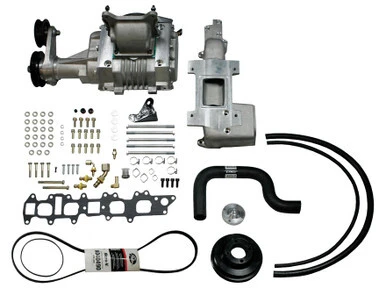
These are Camden superchargers — a roots-type blower developed for automotive use, with a design lineage running back to the first Camden built in 1956 and refined across decades of installations in circle track cars, sports cars, trucks and marine engines.
The features that matter in service: extruded aluminium rotors with Teflon tip seals, pressure lubrication of the rotor shaft bearing, serpentine pulleys, one-piece front extensions and a multi-ribbed rotor housing.
If you are opening the engine anyway, the Pro Turbo/Supercharged cylinder head is the one made for boost. Its 60cc combustion chamber is larger than the naturally aspirated heads, which deliberately lowers compression — exactly what you want with a blower on top, and exactly what you do not want without one. It is not intended for a naturally aspirated engine.
Drive belts are a wear item and they are rib-specific. Check the pulley before you order: 4 rib or 6 rib. Worth keeping a spare with the truck.
Both are on the shelf here and they suit different trucks. A roots supercharger gives you boost from low rpm and behaves like a bigger engine — which is what most people actually want from a 22R in a truck that tows, crawls or gets driven every day. A turbo makes more peak power for the money but wants revs and a more involved install.
If you are weighing them up, read the LCE turbo kits page as well — particularly the part about turbo blocks versus non-turbo blocks, which has no equivalent complication on the supercharger side.