Six of Everything
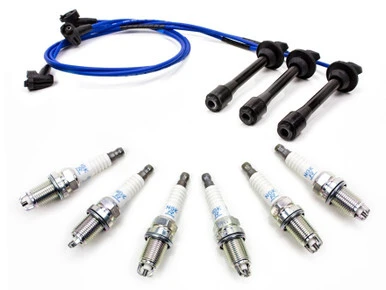
The 5VZ is a V6, so spark plugs are sold individually and you need six. Every plug on this page is priced each. It is the most common ordering mistake on the engine and the easiest to avoid.
Which Plug — and Why There Are Two Iridiums
Three plugs are listed, and the difference between the two Denso parts is heat range:
- NGK BKR5EKB-11 — the conventional plug, and a perfectly sound choice for a stock truck.
- Denso Iridium IK22 — the iridium plug in the standard heat range. This is the one for a stock or lightly modified 3.4.
- Denso Iridium IK24 — a colder plug in the same family, for forced induction or a hard-worked engine.
Colder is not better. A colder plug in a stock engine runs below its self-cleaning temperature and fouls. Only step to the IK24 if the engine is supercharged or genuinely built — and if you are unsure, ask us rather than guessing, because both mistakes look like an ignition fault.
The Street Tune-Up Kit
The Street Tune-Up Kit for the 5VZ-FE pairs components designed to work together.
Ignition parts wear together, and replacing them one at a time means chasing the same misfire three times. If the truck is due, do the set.
Wires — Three Levels
Our Pro set for 1996-2004 uses Magnecor KV85 competition 8.5mm cable. The conductor is a 2.5mm high-capacity metallic inductance EMI-suppressed core — stainless steel wound at 200 turns per inch over a ferromagnetic core, which carries spark energy at very low resistance while suppressing the electromagnetic interference that upsets an ECU.
That last part matters on a fuel-injected engine. Cheap low-resistance performance wires can throw enough interference to confuse the engine management, which produces faults nobody can trace.
There is also a Pro set cut for LC Pro Fuel installations, and factory-equivalent NGK and Denso sets for a standard truck.
Which to buy? On a stock 3.4 the NGK or Denso set is genuinely enough. The Pro set earns its money on a modified or boosted engine, and where routing runs close to exhaust heat.
Coil Pack
The 5VZ coil pack is the replacement for a failed unit.
Before you buy one, rule out the cheap causes. A misfire on this engine is far more often plugs, wires or oil in the plug wells than a dead coil. Swap the suspect components to another cylinder and see whether the misfire follows — that test costs nothing.
Spark Plug Tube Seals — the Leak That Looks Like Something Worse
The spark plug tube seals deserve their own heading.
When they harden, oil from the cam area fills the spark plug wells and sits around the plug and the boot. The symptom is a misfire that comes and goes, and people replace plugs, wires and coils chasing it. If you pull a plug and the well is full of oil, this is your problem — and it is a few dollars, not a coil pack.
Charging
Two high output alternators, split by year and model:
This is the right upgrade once you have added load the factory unit was never sized for — a winch, a light bar, a compressor, or electric fans. The usual sign is voltage that sags at idle with everything switched on.
Sensors
The OEM 3-wire throttle position sensor is here, and the rest of the throttle body parts are on Intake & Throttle Body. Remember it needs a critical adjustment procedure, not just bolting on.
Cam position sensor — buy the genuine one
The camshaft position sensor tells the ECU where the camshaft is, which is what lets it time injection and spark. It fits the 3.4L V6 across 4Runner, Tacoma, T100 and Tundra.
This is a part where the cheap aftermarket version genuinely does not work properly. The sensor has to present the magnetic resistance the Toyota ECU expects, and one that is close but not right produces intermittent stalling or a crank-but-no-start that comes and goes with temperature — the kind of fault that gets a fuel pump and a coil pack replaced before anyone suspects the sensor. We list the genuine Toyota part for that reason.
Chasing a Misfire? Try This Order
- Pull a plug and look in the well. Oil means tube seals, not ignition.
- Plugs — all six, correct heat range.
- Wires — as a set if their age is unknown.
- Coil — and swap it to another cylinder to confirm before buying.
- Then fuel — see Fuel Injection. Measure pressure before replacing anything.
Not sure which plug or wire set your truck needs? Send us the year, model and what the engine is running and we will work it through with you.


 High Output Alternator (U.S. Models ONLY) LC Engineering's high output alternator is the answer to all you charging issues. Running big lights, killer stereo, winch but don't want to change to a...$370.75 - $510.75
 High Output Alternator (U.S. Models ONLY) LC Engineering's high output alternator is the answer to all your charging issues. Running big off-road lights, killer stereo or a winch but don't want to...$370.75 - $510.75