Start Here: Order the Kit That Matches Your Block
Every Pro Turbo kit is listed twice — once for a non-turbo block and once for a turbo block — and they are not interchangeable. This is the single most important thing to get right on this page.
- If your truck came with a naturally aspirated 22RE, you need a NON turbo block kit.
- If your truck came with the factory turbocharged 22RTE, you need a turbo block kit.
If the engine has been swapped, rebuilt or you simply do not know what is in the truck — and on a forty-year-old Toyota that is common — call or email us before you order.
Non-turbo block (22RE)
Low boost · High boost · High boost with ball bearing upgrade
Turbo block (22RTE)
Low boost · High boost · High boost with ball bearing upgrade
Two Things the Kit Does Not Include
1. Your engine has to be able to take boost. We say this on every kit and we mean it. A turbocharger does not fix a tired engine, it finds every weakness in it faster. If the motor has not been apart and you do not know its condition, sort that first — a Premium Master rebuild kit, or one of our forced-induction short blocks.
2. You need engine management. The street turbo kit is designed to run with our Haltech system or any other stand-alone management, together with larger injectors, so the fuel and ignition curves can be set for a boosted engine. Budget for that as part of the project, not as an afterthought. The 750cc flow-matched injector set is the usual companion.
Low Boost or High Boost?
The turbocharger is chosen to spool quickly for street drivability rather than to chase a peak number. It runs a 40 mm external wastegate set at 5 psi, which is plenty for most street engines and can be adjusted by swapping springs. The kit will support 250+ horsepower.
The ball bearing upgrade is worth understanding rather than skipping past: a ball bearing centre section spools sooner and tolerates heat cycling better, which is what you feel on the road rather than on a dyno sheet.
Buying the Turbocharger on Its Own
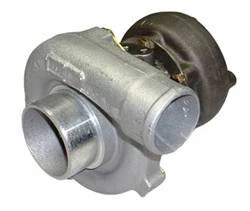
If you are building your own setup, or replacing a tired unit, the turbos are here separately.
Garrett T3/T4 hybrid — the workhorse: low boost, high boost, or high boost with ball bearing.
Smaller frames for faster spool: Garrett GT2554R (low boost) and the Garrett GT2052.
Upgrading a factory CT20 truck is its own path. The CT20 to Garrett GT25R kit for the stock manifold is the complete answer; the CT20 manifold to GT25 adapter is the piece if you already have the turbo.
Worn but rebuildable? The rebuild kit for the Garrett Dynamic T3/T4.
Manifolds
For a factory-style setup, the CNC CT20 stock replacement manifold, or the same manifold with a T2 flange for a GT25 turbo if you are moving off the CT20.
For a purpose-built setup, the T3 manifold for a 40 mm wastegate. Studs: the 22RTE manifold stud set and the CT20 turbo stud kit.
Intercoolers
Boost makes heat, and hot air makes less power and more detonation. Sizing is a packaging problem as much as a flow one — measure the space in front of the radiator before you choose, because the biggest core that will not fit is worth nothing.
Piping: the 2" mild steel J-bend.
Wastegates
The 2-bolt wastegate flange in your choice of style. If you are running our turbo manifold without an external gate, the 40 mm V-band block-off kit closes it off properly.
Oil Feed and Drain — Do Not Reuse These
A turbo lives or dies on its oil supply and drain, and these are the parts people carry over from the old setup when they should not.
Feed: the turbo kit oil feed line, the CT20 to GT25R feed line for an upgrade, the block oil feed fitting kit, and the sealing washers — block side and bolt side.
Drain: the oil drain line, drain plates for the turbo side and block side, the T3/T4 drain gasket and the CT20 oil return line gasket.
Gaskets and Flanges — Match Them to Your Turbo Family
These are turbo-specific, not engine-specific. Work out whether you are on a CT20, a T3 or a GT25/GT28 first.
CT20: the complete gasket set, or individually the inlet, discharge, compressor outlet and water bypass gaskets.
T3: inlet gasket, discharge gaskets in 4 bolt and 5 bolt, and flanges — T3 inlet 4-bolt, exhaust discharge 4-bolt and discharge 5-bolt.
GT25 / GT28: the GT25R metal inlet gasket, the GT25 5-bolt discharge gasket and the GT25/GT28 5-bolt deep discharge flange.
On the exhaust side, the 22RTE bottom-mount turbo exhaust gasket.
Heat
Everything under the hood gets hotter with a turbo on it, and heat soak costs you the power you just paid for. The heat shield for the T3, T4 and GT30R and the turbo performance insulating kit.
Fuel for a Boosted Engine
More air needs more fuel and better control of it. The 750cc flow-matched injector set, the AEM adjustable bypass fuel pressure regulator, and for the factory turbo trucks the Type C injector cap set and Type C Bosch turbo injector connector.
Internals Built for Boost
If you are building the engine to suit the turbo rather than bolting the turbo to what you have, these are specified for forced induction.
Camshafts are chosen by boost level, not by "bigger is better": the Street Turbo cam for 6-10 lbs and the Pro Turbo cam for 10+ lbs.
The Pro Turbo/Supercharged cylinder head has a 60cc chamber, larger than the naturally aspirated heads, which deliberately lowers compression — right under boost, wrong without it. And the Pro Turbo wristpin.
Turbo or Supercharger?
Worth asking before you commit. A turbo makes more peak power for the money and rewards revs; a roots supercharger gives boost from low rpm and needs no separate engine management, which for a truck that tows or crawls is often the better answer. Our 22R supercharger kits are the alternative, and the LCE turbo kits page covers the range across engines.

 Blow Off Valve Weld On Fitting (Race Port) This weld-on adapter is designed to work with our blow of valves when installing on intake tubes. This adapter will fit our Race Port blow off valves...$26.98
 Oil Fitting (28BSPT to 1/8"NPT Female) LC Engineering carries all the components you need to build your own turbo kit or service your LC Engineering Kit. This is a steel fitting that will come in...$26.17
 Garrett T3 Exhaust Discharge Flange (4-Bolt) Use 2.5" OD tubing in the groove or 3" OD tubing outside the groove. 3" OD is tight near the bolt holes but works fine so you're not limited to a 2.5"...$24.84
 Turbo Discharge Gasket (CT20) This is a replacement for the OEM turbo discharge gasket for 22RET engines with the CT20 Turbo. Contact our Tech Support Line for further information at...$24.54
 Header Stud Set Replacing your Turbo manifold? It is a good idea to replace your studs too! LC Engineering offers nothing but the best quality components around. The factory exhaust manifold studs...$23.60
 Turbo Oil Drain Plate (1/2" NPT Boss / Turbo Side) LC Engineering carries all the components you need to build your own turbo kit or service your LC Engineering Kit. This drain plate mounts to the...$21.37
 T3 Turbo Discharge Gasket (4 Bolt) Stainless Steel T3 Discharge Gasket. This product should not be used in a manner that violates Federal EPA Laws. Contact our Tech Support Line for further...$20.73
 Turbo Wristpin LC Engineering can supply replacement wrist pins and locks for our forged pistons. Wristpins are available in either standard thickness (.120") or "Turbo" version (.155"). These...$19.23
 Oil Feed Fitting Kit LC Engineering carries all the components you need to build your own turbo kit or service your LC Engineering Kit. Kit Includes: (1) 12mm Banjo Bolt (1) - 4 AN Banjo...$18.13
 GT25 Turbo Discharge Gasket (5 Bolt) Stainless Steel GT25 Discharge Gasket. This product should not be used in a manner that violates Federal EPA Laws. Contact our Tech Support Line for...$17.54
 Steel Weld-On Flange (Inlet / Outlet) If you are plumbing your wastegate into the exhaust pipe, these fitting are a good starting point. These Turbosmart wastegate flanges make installing your...$17.25
 Turbo Oil Drain Plate (w/ 1/2" NPT Boss For Block Side) Provides a 1/2" NPT port for a custom oil drain fitting. Eliminates the need to use the hard-to-find factory thread fitting that comes from...$17.16