Start Here: What Crawl Ratio Do You Actually Need?
Everything on this page exists to answer one question — how slowly can you go without slipping the clutch. The arithmetic is worth doing before you spend anything, because it tells you which of the three routes below you need.
A stock truck works out at roughly 35:1. That is the factory 2.28:1 transfer case, a 3.93:1 first gear and 3.90:1 differential gears multiplied together. Fine on a fire road. Not enough on a ledge.
From there you have three ways up, in increasing order of money and fabrication:
- 4.70:1 gears in your existing case — roughly doubles your low range. The cheapest real change.
- A complete 4.70:1 case — same result, no teardown of your own case, and you keep the original as a spare.
- Dual cases — a 2.28 and a 4.70 in series takes that same truck to 164:1. This is the big one, and it is also the one that costs you floorboard and driveshaft work.
Route 1: Gears Only
The Trail-Creeper 4.70:1 gear set drops your low range from 2.28 to 4.70 while high range stays 1:1, so nothing changes on the highway. Input gears are precision ground and micro-polished to remove forging imperfections, and the sets carry a lifetime guarantee.
Get the spline count right. Sets come in 21-spline and 23-spline. That is determined by your transmission, not your engine, and it is the single most common ordering mistake on this page.
Fitting gears means splitting and reassembling the case. If that is not work you want to do, go to route 2.
Route 2: A Complete Case
A Trail-Creeper 4.7 single transfer case arrives fully rebuilt and inspected with triple-drilled flanges already installed front and rear. Bolt it in as a straight replacement for your gear-driven case, or use it later as the rear half of a dual setup.
Six versions, and you need three answers to pick one — spline count, shift style and offset:
Offset is the distance between the input and the rear output, and it decides where your driveshaft ends up. Measure before you order.
Route 3: Dual Cases — 164:1
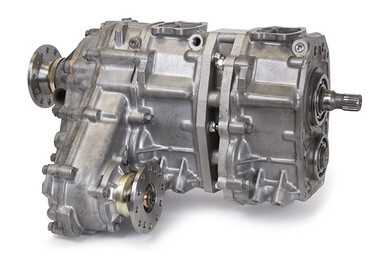
Two cases in series, a 2.28 in front of a 4.70. On the truck in our example that turns 35:1 into 164:1, which is the difference between feathering a clutch over an obstacle and idling over it.
The Trail-Creeper 2.28 x 4.70 dual transfer case fits 1979-1995 Pickups and 1985-1995 4Runners with a compatible transmission. If you already own a suitable case, the 23-spline and 21-spline dual case adapters join them. The adapter castings run thicker walls with oversized gussets, increased oil flow for cooler running, and a retainer ring that stabilises the main bearing rather than the light snap ring used elsewhere.
Be honest with yourself about the install
A dual case is not a bolt-on. Expect to shorten and re-tube both driveshafts, cut a second floorboard hole for the front shifter, extend the speedometer cable and replace the crossmember. Budget the fabrication alongside the parts.
Tacoma and V6 trucks
For the 1995-2004 Tacoma, the Tacoma dual case adapter kit mates the factory transmission to a mini-truck crawl box and then to your transfer case. It still needs an additional top-shifting gear-driven case plus driveshaft and floorboard work.
For 1988-1995 3.0L V6 trucks, the V6 adapter plate bolts gear-driven cases to the V6 five-speed — using all nine transmission bolts, and with countersunk hardware so the transmission needs no machining. The factory V6 chain-drive case cannot be used for this; the conversion needs at least one top-shift gear-driven case.
Shifting It: Top Shift, Forward Shift and Twin Sticks
Most dual-case and 4.70 builds end up converting a forward-shift case to top shift, because a doubler leaves no room for the forward linkage. Three kits, in ascending order of what they include:
- Style A — rails, fork, fork tube and pins, all new, pre-machined to accept a 3.70:1 low range input gear set.
- Kit B — adds the shifter and the block-off plate for the now-redundant hole in the transmission.
- Style C — adds a twin stick.
Twin sticks are worth understanding before you buy one. A top shift or forward shift Creepy twin shifter separates the high/low and 2WD/4WD rails so you can run low range in two-wheel drive — which steers far better and stops the driveline binding when you are shuffling between obstacles. It also lets you drop in and out of 4WD without stopping. Installation requires removing the interlock pin from the case. Bases are polished cast aluminium with heat-treated 1020 steel keys, and there is a twin stick boot to keep engine heat out of the cab.
The small parts that fix a sloppy shifter
Before assuming the case is worn, replace the wear items. Heavy duty shift springs are the fix for a lever that pops out of gear on the trail — we recommend them with any 4.70 gear set or dual adapter, using two in the rear case and one in the front box, along with the heavy duty detent bolt.
The other usual culprit is the shift lever ball seat, which goes hard and crumbles. Ours are hardened urethane with machined side grooves so they rotate into place instead of being squeezed in. Order by diameter, not by guess:
- Red, 1.600" — 1985-1988 W56-A and W56-B
- Blue, 1.530" — forward shift cases: G52, G54, W56-C/D/E, R151F and 1988-95 R150F, plus top-shifting chain drive
- White, 1.655" — most other 1981-on L, G, W and R series
Also here: a stock replacement shifter kit, a shift base, the genuine Toyota shifter boot (33555-20060) that keeps mud out of the case when the original crumbles, and a rubber shift knob.
Rebuilding and Sealing
If the case is noisy or leaking, rebuild it before you gear it. Two kits, both using SKF, NSK, NACHI and KOYO bearings: the minor kit covers bearings, gaskets and seals; the major kit adds roller bearings and flange nuts. Both suit 1979-1995 gear-driven cases.
For leaks alone, the 1987-1995 gasket kit reseals a case during service. The heavy duty rear output seal is the one to fit if you leak on steep inclines, and it doubles as a front output seal if you replace the factory dust shield with it. Grease the inner diameter only — never the outer.
Output hardware: the 27-spline triple drilled flange carries every common 1984-1995 pattern in one part — 4-cylinder CV and non-CV plus V6 CV — which makes sourcing or reversing driveshafts far easier. It will not work with stock Toyota drivelines. Add a dust flange to keep debris off the seal, and note that the flange nut is staked in service and should not be reused.
Holding It Up, and Holding It Still
Lower gearing means more torque through the mounts and more time dragging the case over rock.
Mounts: the V6 mount has a larger mounting surface than the 4-cylinder part and works as a stock replacement on 1982-1995 4-cylinder trucks too. Sky's heavy duty mount replaces the soft rubber centre with Energy Suspension polyurethane, on thicker laser-cut plates — worth having if your shifters move enough to hit the cab.
Crossmembers, all 3/8" plate steel and shipped raw:
Parking brake. Rear disc conversions and axle swaps often leave the factory parking brake useless. Two answers, both mounting at the transfer case output where the differential ratio multiplies your holding force: the transfer case e-brake kit, a low-profile bolt-on for all gear-driven cases in about an hour, and the All-Pro disc parking brake, which connects to the stock cable, needs no driveshaft modification and will hold a truck on a 45-degree hill in neutral. The All-Pro kit is 4-cylinder manual transmission only.
What We Would Fit
- Weekend trail truck, mostly fire roads — leave the case alone. Fix the shifter seat and springs and spend the money on tyres.
- Technical trails, still drives to work — 4.70:1 gears or a complete 4.70 case. Roughly doubles your low range and changes nothing on the highway.
- Dedicated crawler — dual cases, twin sticks and a crossmember. Plan the driveshafts and floorboard work into the build from the start.
Not sure which spline count or shift style you have? Tell us the year, model and transmission and we will identify it for you.


 HD Transfer Case Output Seal (Rear) Tame your rear driveline and prevent leaks while on a steep incline starting today! Optionally, this rear EcoSeal can be used as a front output seal. Simply...$21.50
 Heavy Duty Shifter Seat (Blue) It's common for the factory shift lever ball seat to wear, crumble and disintegrate over time. This often results in a sloppy or loose t-case shifter. The factory...$14.87
 Heavy Duty Shifter Seat (White) It's common for the factory shift lever ball seat to wear, crumble and disintegrate over time. This often results in a sloppy or loose transmission shifter. The...$14.41
 Heavy Duty Shifter Seat (RED) It's common for the factory shift lever ball seat to wear, crumble and disintegrate over time. This often results in a sloppy or loose transmission shifter. The...$14.40
 Trail-Gear Shift Knob 4WD/2WD Upgrade or replace your worn-out factory hardware with the Trail-Gear Rubber Shift Knob. Designed for durability and a comfortable grip, this knob is the perfect...$12.99
 Transfer Case Dust Flange Dust shield for use with triple drilled output flange. Keeps rocks and other trail debris from damaging seals behind the output flange on your transfer case. This...$9.99
 Heavy Duty Shift Spring (Transfer Case) The stock transfer case shift springs tend to give a sloppy feel to the shifters and can lead to the transfer case shift lever popping out of gear on the...$6.99
 8" Pinion & Transfer Case Flange Nut The flange nuts are recommended to be staked or peened over to lock so they are not considered reusable. This stock replacement nut is used on the 8" pinion in...$4.99
 Shift Detent Bolt (Heavy Duty Transfer Case) The stock transfer case shift springs tend to give a sloppy feel to the shifters and can lead to the transfer case shift lever popping out of gear on...$4.99