This Page, and the One You Might Actually Want
Worth thirty seconds so you end up in the right place.
This page is about the carburetor itself — which Weber to run, how to jet it, how to rebuild it, and what to feed it. Everything here works across both carbureted Toyota fours.
If you want a complete bolt-on package for a particular engine — carb, matched intake manifold, adapter, linkage and air cleaner assembled for your truck, including the smog-legal kits for specific years — go to 22R Carburetors & Intake or 20R Carburetors & Intake instead.
Rule of thumb: choosing a carburetor, jetting it or fixing it — you are on the right page. Buying a whole setup for your engine — use the engine pages.
Downdraft or Sidedraft? The Honest Answer
People arrive assuming sidedrafts are simply the better part. They are the bigger part, which is not the same thing.
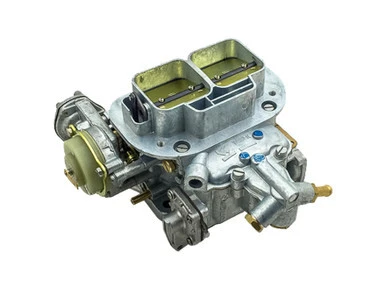
Downdraft — 32/36 and 38. A progressive two-barrel that opens the small primary first and brings in the secondary under load. It idles cleanly, drives well cold, returns sensible fuel economy and fits under a stock bonnet with a conventional air cleaner. For a street truck, a trail truck or a tow rig, this is the carburetor.
Sidedraft — DCOE 40mm, 45mm, 48mm. Two throttle plates opening together straight into the ports. More airflow, sharper throttle response, and a considerably more demanding part — a dedicated manifold, more linkage, more jetting work, and synchronising to do. For a race engine with a big camshaft, they are transformative. On a mild street engine they are usually slower than a well-jetted downdraft, not faster.
Choosing between 32/36 and 38
The 32/36 has a 32mm primary and 36mm secondary. It is the default recommendation for a stock or mildly modified 20R or 22R and the one we sell the most of.
The 38 runs two 38mm barrels that open together. It suits an engine that is already breathing — a performance camshaft, a header, a ported head. Fitted to a stock engine it tends to feel soft at low rpm, because there is no small primary barrel doing the part-throttle work.
Both come with a manual or electric choke. Electric is more convenient. Manual is one less wire and one less thing to fail on a trail truck — and there is a universal choke cable if you need one.
Carburetor only: 32/36 electric · 32/36 manual · 38 electric · 38 manual
Sidedrafts, if you have decided
Available as 40mm, 45mm and 48mm. Size by engine capacity and rpm, not by ambition — an oversized venturi kills low-speed signal and makes the carb almost impossible to jet.
Sidedrafts need supporting parts that downdrafts do not: a throttle linkage kit, a synchronizer to balance the throttle plates, velocity stacks and dome screens. The synchronizer is not optional if you want the engine to idle.
Jetting — the Part That Actually Decides How It Runs
A Weber out of the box is jetted for an average engine at low altitude. Yours is probably neither. More tuning complaints come down to jetting than to anything else on this page.
Three circuits, and each one owns a part of the rev range:
If you live above about 4,000 feet, read this
Thinner air means a factory-jetted carburetor runs rich — you get a sooty plug, a smell of fuel and worse economy, and people usually blame the carburetor rather than the altitude. The high elevation jet kits fix it: 32/36 manual choke, 32/36 electric choke and 38.
Chasing power rather than altitude: the 32/36 DGEV performance kit and the 38 DGS performance kit. For sidedrafts, the DCOE kits are grouped by venturi size — 28-30mm, 34-36mm, plus a main and air correction set and an F8 idle jet kit.
Working it out yourself? The Haynes Weber tuning manual is the reference we hand out most often.
Fuel Pressure — the Silent Cause of a Flooding Weber
A Weber wants roughly 2.5 to 3.5 psi. An electric pump intended for fuel injection will push far more than that, force fuel past the needle and seat, and flood the carburetor. The symptom looks like a failed float valve, and replacing the float does not fix it.
If you have fitted an aftermarket pump, fit a regulator. The Weber regulator adjusts 1.5-12 lb; there is a boost-referenced version, 1.5-20 lb for blown engines, and a Holley 1-4 lb regulator. Regulator-and-gauge kits are available with liquid or dry gauges — liquid-filled reads more steadily on a truck that vibrates.
Running the mechanical pump on a carbureted 22R, the mechanical fuel pump spacer covers 1981-1995.
Rebuilding and Wear Parts
A Weber that has sat is usually a Weber with a hardened float valve and dried gaskets, not a worn-out carburetor. Rebuild before you replace.
32/36 DGV kit · 38 DGAS kit · 40/45mm DCOE kit — one kit per carburetor on sidedrafts.
Individually: brass and foam floats, the power valve, gasket kit, base gaskets in Teflon and Red Line, idle jet holders primary and secondary, the internal fuel filter, and for sidedrafts the O-ring and isolator kit.
Choke and linkage: genuine electric choke, idle cut-off solenoid, 32/36/38 linkage kit and cable linkage kit.
Air Cleaners
A Weber will not accept the factory air cleaner without help. Options run from the stock replacement filter and a K&N element, through the K&N adapter kit, up to the LCE Pro billet air cleaner. Adapters to keep the factory air cleaner are engine-specific and live on the engine pages: 22R and 20R.
What We Would Fit
- Stock or mildly modified street truck — 32/36 with an electric choke. Jet for your altitude and leave it alone.
- Cammed and headered street or trail engine — 38, manual choke if it lives off-road, plus a performance jet kit.
- High altitude, any engine — whichever carburetor suits, and budget for a high elevation jet kit on day one.
- Race engine, big camshaft, high rpm — sidedrafts, with the synchronizer and linkage. Expect to spend real time jetting.
Not sure which carburetor or which jets? Tell us the engine, the camshaft and your elevation and we will spec it.

 Sidedraft Carburetor (Weber 48mm) The Weber 48mm sidedraft intake system is an excellent performance upgrade for your 20R and 22R. The venerable DCOE is Weber's premier carburetor and is the...$795.11