The Question That Decides This Whole Page
Before anything else: does the camshaft you want run on the factory valvetrain, or does it need upgraded parts to go with it?
Getting this wrong is expensive in a specific way — the cam goes in, runs fine for a while, and then the springs it was never meant to work with let it down. Every cam here states its requirement, and the two ends of the range make the point:
- The Pro Torquer is designed to work with the factory valve train — no springs, no retainers, nothing else to buy.
- The Stage 5 is a race grind for high-rpm naturally aspirated engines with larger valves and aggressive port work, and it requires an upgraded valvetrain.
If you are comparing grinds, compare duration at .050" valve lift. That is the number that means something; advertised duration is not comparable between manufacturers.
Camshafts
All LCE camshafts are ground on new billets and double heat treated, and tested on the street, the track and off-road.
Buying the cam and the valvetrain together is cleaner: the Pro Camshaft Kit with titanium retainers or with chromoly retainers.
To degree a cam in properly rather than trusting the marks, the camshaft alignment and degreeing tool kit. Adjustable cam gears for single row and dual row chains.
Cylinder Heads
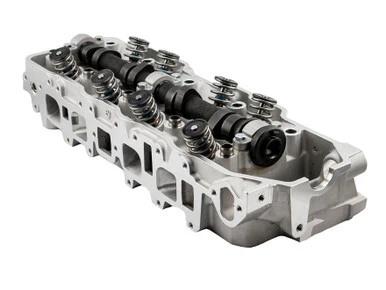
All for the 1985-1995 22R and 22RE, in ascending order of intent: Street Performer, Pro, Stage 2, Stage 3, Stage 5.
The Pro Series is a stock replacement with mild performance upgrades, compatible with stock fuel injection, and gives 18-20 HP over stock. That is the head for a stock or mildly built truck. As with the cams, a higher number is not automatically a better truck — a Stage 5 head on something that tows will be worse to live with than a Street Performer.
The boosted head is not an upgrade for a normal engine
The Pro Turbo/Supercharged head has a 60cc combustion chamber, which is larger than standard and therefore lowers compression. That is exactly what you want under boost and exactly what you do not want without it.
It is not intended for naturally aspirated engines. It is a stock replacement for the 22RT-E head, or a way to drop compression further on a custom turbo build. It comes with 45.5mm stainless intake and 37.5mm stainless exhaust valves, street springs and retainers, hardened keepers, OEM-style Viton seals, new intake and exhaust studs and mild port work.
For the full range across every engine we build heads for, see LCE cylinder heads.
Valve Train Kits
If you are rebuilding the top end rather than buying a finished head, the Pro valve train kit for the 22RE/RET and the carbureted 22R version. Valve kits by stage: Pro / Stage 2 / Stage 3 and Stage 5.
Valves
Stainless, in stock length and long: intake 45.5mm stock length or 45.5mm long, exhaust 37.5mm stock length or 37.5mm long. Oversize for ported heads: 48mm intake and 40mm exhaust. Stock-size steel replacements: intake and exhaust.
Check length before you order. Stock length and long are not interchangeable, and the choice follows the head and the spring package, not preference.
Springs, Retainers and Keepers
Springs: Street Performer set and Pro dual spring set.
Retainers are where titanium and chromoly diverge: Pro titanium set (or each), Pro chromoly set (or each), and Street Performer single-spring style or each.
Simplest route is the matched kit: dual spring with titanium retainers or with chromoly retainers. Plus hardened keepers and spring seat shims for setting installed height.
Guides, Seats and Seals
Guides: Pro bronze set of 8, bronze each, or OE stock set. If you fit the bronze guides, use the Viton seal set made for Pro guides — the seals are guide-specific.
Stainless seats, sized to the valve: exhaust 36mm (20R), 37.5mm, 40mm; intake 44mm and 45.5mm/48mm.
Rocker Gear and Adjusters
The 22R needs its valves adjusted, so these wear. Rocker sets with adjusters and nuts: OEM and OE. Assemblies: OEM, OE, and the Pro rocker shaft set. Individual aluminium rocker arms, rocker arm shims, and adjusters: LCE, OEM and the OEM adjuster nut.
The Pro rocker shaft is worth a sentence of its own. Toyota discontinued the rocker shaft, so we went to the original manufacturer in Japan and had them built to the same dimensional specs — then fixed the part that actually fails. The stock shaft has two small oiling holes and shallow grooves, which is not enough oil for high rpm or hard duty. Ours are heat treated, hard chromed and carry four large oiling holes.
Holding the Head Down
Bolts are what the engine was designed around and are right for a stock or mild rebuild: OEM 1985-1995, OE 1985-1995 and OEM 1975-1984. They are torque-to-yield — do not reuse them.
The Pro head stud kit is the answer once cylinder pressure goes up — high compression pistons, nitrous, a turbo or a supercharger. 8740 chromoly, heat treated and centreless ground to a tensile strength over 190,000 PSI, which gives a higher and much more consistent clamping load than factory hardware. It also makes the head easier to remove next time.
Alignment detail people forget: the dowel pin that locates the head on the block, the camshaft cap and timing cover locator dowel, and Viton valve seals for stock guides. Head gaskets themselves — and the thickness question, because gasket thickness changes your compression ratio — are on the gaskets and seals page. If your head has been milled hard, ask about the head shim there before you assemble.
If You Are Making Real Power: the Block Brace
Worth knowing before you build past roughly 185 horsepower. Toyota engineered the 20R and 22R block for what a 1980s pickup asked of it, and the casting has a known weak area around the engine mount bosses. Under hard acceleration, or in a stiff chassis with little flex, those concentrated stress points can crack a block.
The Pro Block Brace Kit is 1/2" steel and bolts directly on. It is aimed at circle track, rock crawling and heavy duty use. If you are ordering a Stage 3 or Stage 5 head, consider it at the same time — it is inexpensive insurance against the one failure a rebuild cannot fix.
Finally, the OEM crankshaft main and camshaft bolt kit — the fasteners you should not reuse.

 OEM Rocker Arm Set (Adjusters & Nuts) Save big money over purchasing separately. This is a set of (8) rocker arms for the 20R and 22R/RE/RTE Toyota 4 cylinders. A genuine Toyota Part from Toyota...$492.75
 Rocker Arm Assembly (OE) We at LC Engineering supply only the best OE parts accompanied by our Pro Rocker Shafts with four large oiling holes as opposed to the two small holes on the OEM shafts...$418.92
 Outlaw Camshaft Now here's the BIG DOG!! The .527" lift Outlaw cam is the biggest cam LC Engineering makes! This is a full race cam designed to be used with oversized valves and a highly modified...$398.30
 treet Turbo (6-10lbs of Boost) The Street Turbo cam is designed to work with low boost levels (6-10 psi). It will work with all the stock valvetrain and require no other modifications to run. LC...$398.30
 Stage 3 Torquer Camshaft This camshaft has one of the best torque curves you could ask for, which makes it perfect for rock crawling, rock racing, or just about any large tire application. This...$398.30
 Stage 2 Camshaft A Stage 2 cam will give you excellent mid-range power up to around 6,000 RPM. The broad midrange this cam provides makes it a great upgrade for anything from a daily driver up...$398.30
 Stage-3 The Stage 3 cam is designed to work with some larger valves, port work, and upgraded carburetor or EFI system. This cam starts moving the power band a little higher in the RPM range...$398.30
 Stage-4 The cam has an excellent upper RPM power band while still keeping a strong torque curve throughout the 3,000 to 5,000 RPM range. The RPM curve created by the cam makes it an excellent...$398.30
 Stage-5 This is a race application camshaft designed for higher RPM, Naturally Aspirated engines using larger valves and very aggressive port work. This is an excellent choice for racers of all...$398.30
 Pro Turbo The Pro Turbo cam is amazing for high boost (10+ lbs. of boost) turbocharged applications. It is engineered to optimize exhaust flow while driving the turbo for increased spool up speeds...$381.09
 Street / EFI Pro LC Engineering's Street / EFI Pro Camshaft is an excellent upgrade to any mild engine application that will use the stock Aisin or Weber 32/36 carburetor as well as the factory...$370.44
 Pro Torquer LC Engineering's EFI Pro Torquer Camshaft is an excellent upgrade to any mild engine application. This cam is compatible with a carbureted or factory fuel injection setup. This cam...$370.44